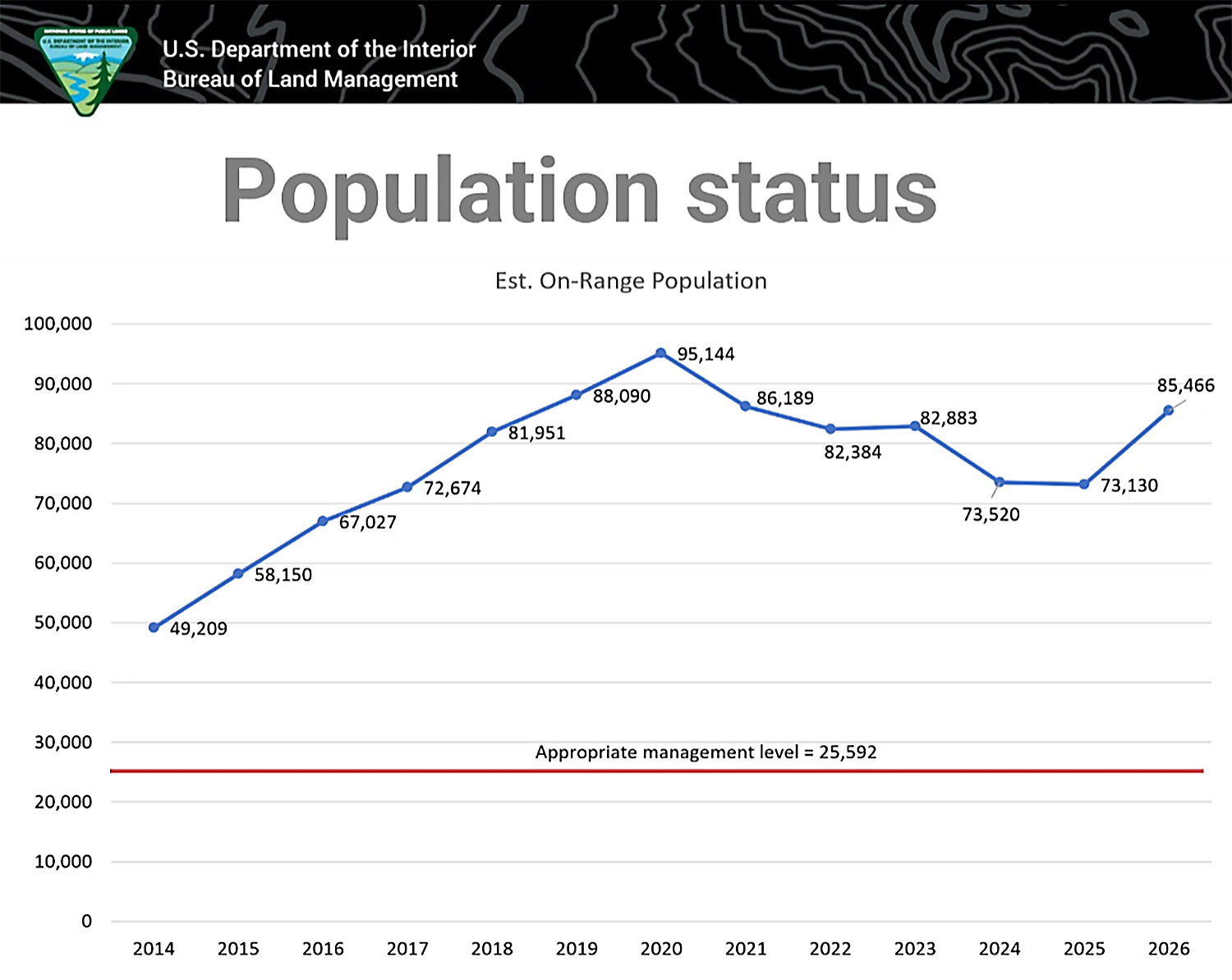
Wild Sheep Foundation President and CEO Gray Thornton said that number underscores the scale of the challenge. “There are roughly 85,000 feral horses and burros on BLM lands today, and about 85,000 bighorn sheep across the United States, Canada and Mexico. One is a non-native population concentrated on public lands, and the other is a native species spread across an entire continent. That comparison puts the scale of the imbalance into perspective.”
WSF supports the Bureau of Land Management’s ongoing science-based efforts to manage these populations and maintain healthy habitat on public lands.
A Growing Problem and a Familiar One
Each spring, BLM officials conduct population inventories and release a gather schedule outlining where excess wild horses and burros will be removed from the range to keep populations in balance with available habitat. Removed animals are placed into holding facilities or made available for adoption. This is standard management, not a new or reactionary policy. Charlie Booher of Watershed Results, a firm that specializes in natural resource conflict resolution and stakeholder engagement, said BLM follows a consistent management framework each year, but the challenge now is the scale.
“It’s a serious problem, and it’s going to require more resources and more authority to actually get a handle on it,” he said. On-range populations increased from roughly 72,000 animals in early 2025 to about 85,000 today, a jump of more than 13,000 horses and burros in just one year. The biggest driver behind the recent population spike was the absence of normal management in 2025, when gather operations were paused due to funding limitations. “This is a perfect year-over-year example of what happens when we don’t do gathers,” Booher said.
Costs, Constraints, and a Growing Challenge
The scale of the issue is not only ecological, but financial. The Bureau of Land Management now spends more than $150 million annually to manage wild horses and burros, with most of that funding going toward the long-term care of animals removed from the range.
Today, more than 60,000 horses and burros are held in off-range corrals and pastures, with lifetime care costs estimated at roughly $15,000 per animal. That growing population in holding represents a long-term obligation for taxpayers, with total liabilities reaching into the billions.
Adoption programs remain a tool, but they have not kept pace with population growth. In recent years, the number of animals removed from the range has often exceeded the number placed into private care, meaning more horses are entering the system than leaving it.
Wild horses and burros are often portrayed by animal advocacy groups as enduring symbols of the American West, which has led to strong emotional responses around their management. That connection makes it more difficult to apply the same science-based approaches used for other wildlife and land management challenges. In contrast, feral hogs in the Southeast are routinely managed through lethal removal on public lands, often with little public outcry.
Management decisions are often constrained even as conditions on the ground continue to deteriorate. These limitations are further shaped by the legal structure governing how these animals can be managed.
The Federal Framework Behind Management
Wild horses and burros are managed under the Wild Free-Roaming Horses and Burros Act of 1971, which requires federal agencies to protect and manage these animals as part of a multiple-use framework while maintaining healthy rangelands.
Under that law, agencies must determine AML and address excess animals when populations exceed what the range can sustain, with adoption and off-range holding among the primary tools used in practice. While the law provides broader authorities, appropriations language over the past several decades has limited how those authorities can be applied. In practice, federal agencies have not used authority to destroy healthy animals, and funding restrictions prohibit the use of federal dollars for commercial processing. In practice, population reduction relies primarily on gathers, adoption, long-term holding, and fertility control.
Why Active Management Is Required
Wild horses and burros are managed differently than most other species on public lands. Native wildlife populations are typically regulated through hunting and natural predators, while livestock grazing is managed through permits and strict controls. Wild horses and burros, however, are not managed through hunting and lack natural predators capable of controlling their numbers. According to the BLM, unmanaged herds can double in size every four to five years and quickly exceed the land’s ability to support them. Maintaining herd size at appropriate levels is essential to ensuring healthy animals and healthy rangelands.
BLM management therefore relies on a combination of tools. Gathers are used to remove excess animals and protect both the animals and the land, while fertility control is applied in some areas to slow population growth where it is feasible.
Absent these efforts, populations expand rapidly and can overwhelm available food and water resources, causing long-term damage to habitat that can take decades to recover.
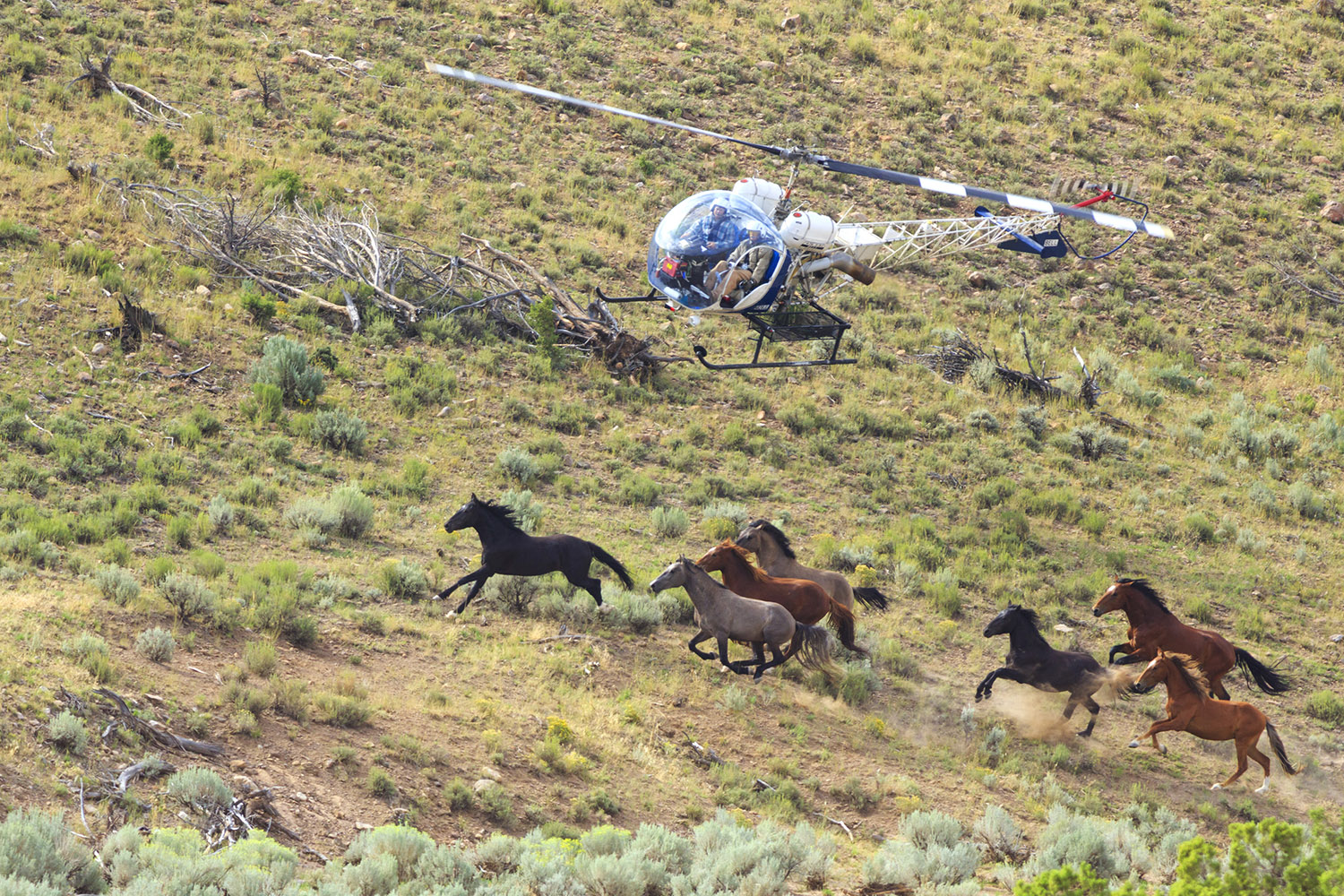
A herd of wild mustangs being herded with a helicopter in southern Utah, during a BLM gather operation. The feral horses are overloading the local water sources, requiring additional management.
Impacts Across the Ecosystem
While wild sheep are a central concern for the WSF and its membership, they are far from the only species affected. Feral horses and burros compete broadly with native wildlife, including mule deer, pronghorn, and upland bird species, for the same limited resources.
“Horses obviously outcompete all of those for water and have a big impact on the habitat overall,” Booher said. In arid and semi-arid environments, water is the limiting factor. Springs and guzzlers that sustain desert bighorn sheep and other wildlife are often dominated by large bands of horses and burros. These areas can be trampled, overgrazed, and degraded, reducing their value for native species. For wild sheep, this pressure directly affects habitat quality, access to water, and long-term herd health.
Drought, Overpopulation, and the Cost of Inaction
All of this is unfolding against the backdrop of a worsening drought across much of the West.
“We’re staring down the barrel of a generational drought year,” Booher said.
In drought conditions, water and forage become increasingly scarce at the same time populations are at record highs. Springs dry up, forage production declines, and wildlife are forced to compete more intensely for fewer resources. In those conditions, horses themselves begin to decline as well, with reduced body condition and increasing competition for limited water and forage.
For wild sheep, that can mean reduced lamb recruitment, poorer body condition, and limited access to critical water sources. For other species, including mule deer, pronghorn, and upland birds, the impacts can be equally severe. At the same time, large concentrations of feral horses and burros often dominate remaining water sources, further limiting access for native wildlife. Without active management, these conditions can quickly lead to widespread stress and die-off across the landscape.
“And so, the conditions for the summer of 2026 are going to merit probably some emergency gathers, and we’re going to see a lot of horses suffering from dehydration and starvation,” Booher said. When populations exceed what the land can support, the outcome is predictable. Range conditions decline, wildlife habitat is diminished, and animals begin to suffer. “Not only is this a problem that’s bad for wildlife and bad for the range itself, but it’s also bad for the horses,” Booher said.
Without management, both the landscape and the animals that depend on it pay the price.