NAHUSH TIRUMALA
$5,000 + TRIP TO SHEEP SHOW
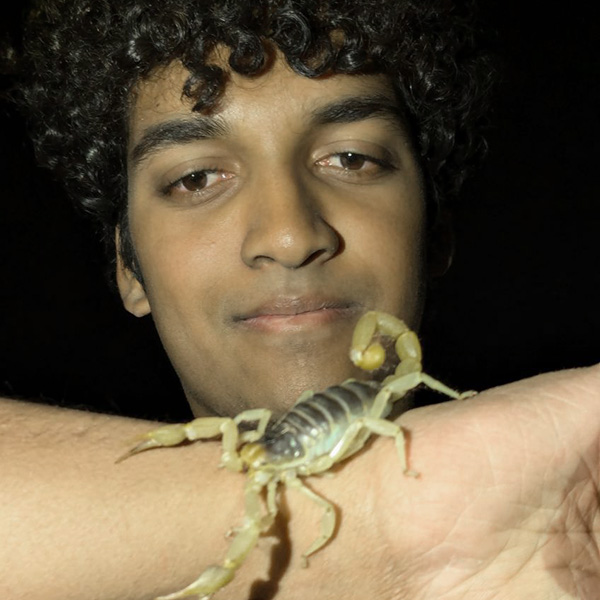
Although born in the United States, Nahush Tirumala spent much of his childhood in Mumbai, India, where his passion for wildlife conservation first took root. Growing up in one of the world’s largest urban environments, he became deeply aware of the challenges surrounding human-wildlife conflict. Near his home, leopards roamed within a national park increasingly threatened by urban encroachment, bringing both danger and difficult realities for wildlife and local communities alike. Witnessing these conflicts firsthand shaped his early understanding of conservation and inspired his desire to become part of the solution.
Starting his junior year at University of Arizona, he is pursuing a Bachelor of Science degree in Natural Resources with an emphasis in Wildlife Conservation and Management, along with a minor in Marine Science. Nahush has quickly distinguished himself through leadership, field experience, research, and service.
As a member of the University of Arizona Fish and Wildlife Society (UAFWS), one of the oldest student-run organizations on campus, he immediately immersed himself in hands-on conservation work. His efforts have included removing invasive plant species on local ranches, participating in invasive turtle and bullfrog removal projects along the Santa Cruz River, and contributing to community clean-up initiatives such as the Arroyo Chico Wash restoration effort.
His enthusiasm and commitment quickly earned the respect of his peers. During his freshman year, Tirumala was elected Treasurer of UAFWS and has since advanced into the role of President. He also successfully led efforts for the organization to become an affiliate of the Arizona Wildlife Federation and represented the club at The Wildlife Society annual meeting.
As a Peer Mentor for the School of Natural Resources and the Environment, he supports fellow students and incoming freshmen while helping organize events that strengthen community and student engagement within the college.
His commitment to conservation education extends beyond the university setting. Through the prestigious Bio/Diversity Project internship, Tirumala taught middle school students about biodiversity, conservation, and environmental stewardship while balancing a full college course load. Over the course of ten weeks, he helped lead lessons, hands-on activities, and field experiences in Arizona’s Sonoran Desert, helping young students better understand the importance of protecting wildlife and natural ecosystems.
Tirumala has also gained valuable field and research experience through a variety of conservation initiatives. He has worked as a Herpetology Field Technician conducting invasive species research, participated in important bird area surveys through the Tucson Audubon Society, contributed to projects with the Arizona Game and Fish Department, and even re-discovered a specimen of the extremely rare scorpion species during a BioBlitz event at the Santa Rita Experimental Range.
His conservation experience reaches far beyond Arizona. Tirumala has participated in wildlife and habitat conservation efforts across India and Nepal, including expeditions focused on endangered red pandas in the Himalayas and work connected to conservation initiatives in Kanha National Park, Periyar Tiger Reserve, the Nilgiri Biosphere Reserve, and the Western Ghats. He has also volunteered with youth and wildlife organizations and co-founded a student-led climate action club focused on afforestation efforts and coastal clean-up projects.
International conservation work continues to play a major role in his academic journey. In summer 2025, Tirumala participated in research with the Charles Darwin Foundation in the Galápagos Islands, where he assisted with marine organism collections, bivalve research, and early studies related to giant tortoise evolution. In the summer of 2026, he further expands his field experience through conservation studies in Namibia and along the Angola-Namibia border, focusing on African megafauna, indigenous conservation practices, and the complexities of human-animal conflict in the Namib Desert region.