Please Wait a Moment
X
Ram Revival

The Conservation Movement Behind the Big Wave of Record-Breaking Bighorns

By Chester Moore

For eight years, North Dakotan Nick Schmitz put his name into the state’s once-in-a-lifetime bighorn sheep draw, never truly expecting to pull the tag. When he finally did, he called his friend and fellow sheep hunter David Suda, the man who had taken North Dakota’s previous state-record ram in 2020 with an absolute giant measuring 186 3/8 Boone and Crockett (B&C). If anyone understood the rugged, stair-stepped terrain of the Badlands and what a truly mature ram looked like, it was Suda. Schmitz made three scouting trips before the season opened, driving from the far eastern side of the state into the western Badlands where the sheep live.

Badlands bighorn ram by Maxwell Roelfsema
Photo Courtesy Maxwell Roelfsema

“I live on the eastern side of North Dakota, and the sheep are all on the western side of the Badlands,” he said. His early trips were quiet with warm weather, little movement, and rams still bunched up.

He arrived a week before the opener to scout and stay close to the unit. Somewhere in that country lived a heavy ram they’d seen in photos, one Suda who had joined him for the hunt believed had true potential. On opening day, late in the afternoon, Suda, walking a bit ahead, caught movement ahead.

“He turned back to me and said, ‘Hey, get down. We have some sheep over here,” Schmitz said. At first, he saw only ewes. Then the ram stepped out. “Just from the naked eye, I could tell he was massive and we knew it was the one we were looking for and that's when the nerves set in,” he said.

The moment that followed was the kind sheep hunters dream of, with quiet air, fading light, and a big ram standing broadside. It took a few moments for Schmitz to collect himself and take the shot, and the first one…missed. The second shot connected, and after an insurance shot the tough, old ram fell. At this point Schmitz felt everything at once: the years of applying, the long drives west, the scouting trips, and the privilege of hunting beside a friend who had once stood in his shoes.

When biologists tallied the ram’s green score at 197 6/8 B&C, Schmitz realized he had taken a pending North Dakota state record, surpassing even Suda’s remarkable ram from four years earlier. It was a truly massive animal weighing 264 pounds with the head only scaling out at nearly 50 pounds. What he didn’t yet know was that his ram wasn’t an anomaly. It was part of something much larger happening across the West, a conservation-driven resurgence producing more old, heavy rams than we’ve seen in years.

From Canada to Mexico, hunters have taken truly giant rams in recent seasons, but for now, we’re zeroing in on a handful of record-breakers that define this new era.

Revival Rumblings

The modern wave of giant bighorn sheep didn’t start with a dramatic hunt, but quietly with two rams from Montana’s Wild Horse Island in 2016. Their B&C scores of 205 2/8, 209, and ultimately a 216 ⅜, ram that still stands as the world-record Rocky Mountain bighorn.

A hunter didn’t take them; they were pick-ups. Wild Horse is a state park and a nursery herd for translocations of surplus animals. Still, it revealed the importance of age, quality habitat, and genetics–genetics that have been transferred across the West. Age structure for one was returning to specific areas in sheep country, and the very top end of the population curve was growing.

Recent North Dakota Rams

Hunter with the ram he harvested with the 2025 North Dakota permit tag

Jim Swenson purchased North Dakota's special permit and connected with this ram.

Elated hunter with the Badlands ram known as the White Whale

Ross Pfleger harvested this Badlands ram known locally as the White Whale.

Bighorn rams on Wild Horse Island courtesy of L. Victor Clark

Bighorns from Montana's Wild Horse Island are legendary and have been used on translocations across the West.
Courtesy L. Victor Clark.

In 2018, South Dakota delivered a giant of its own when Clayton D. Miller arrowed a 209 1/8 Badlands ram that was the largest hunter-harvested Rocky Mountain bighorn ever recorded. This surpassed Guinn Crousen's 208+ ram and was the largest archery and largest hunter-harvested bighorn sheep. The wave crested again in 2019.

In Idaho’s Hells Canyon, Doug Sayer harvested the ram known as “The Duke,” an old monarch officially scoring 200 1/8 B&C, a benchmark for the state and still the official Idaho state record. Pennsylvania hunter Gary Guerrieri took the new Washington state-record Rocky Mountain bighorn in Asotin County in 2021. The ram scored 202 4/8. The massive animal, with measured horn lengths of approximately 44 and 44 2/8 inches and bases exceeding 17 inches, came from rugged terrain near the Grand Ronde River in the Columbia Plateau region.

Even states with smaller or once-struggling herds began joining the trend.

In 2021, Nebraska added one of the most surprising record rams in modern memory with a Banner County brute officially recorded at 201 5/8 B&C. The hunter, Grant Smith, had been scouting with longtime biologist Todd Nordeen, whose decades of work in the Panhandle helped rebuild a herd many once believed would never produce a ram of that caliber.

“It’s always impressive to see a big ram, but for a state like ours on the fringe of bighorn territory to produce a ram like this was special for us,” Nordeen said.

Capture project in Nebraska to test, collar, and release bighorn sheep.

Capture project in Nebraska to test, collar, and release bighorn sheep.

Meanwhile, Colorado’s story surged past expectations. According to B&C officials, the state had gone more than two decades without a new record ram and then saw two number-one rams within weeks, pushing Colorado into the 200-point class for Rocky Mountain bighorns for the first time. In 2022, Kevin Neil spent 21 days in the backcountry and killed a 200-inch ram that held the state record for roughly two weeks before a Fremont County pickup ram surpassed it a few weeks later by four inches.

Mike Kinney’s California bighorn sheep, taken in 2022 in Oregon’s lower John Day River region, was confirmed by Safari Club International as the new world-record California bighorn with an official score of 191 5/8 inches. Boone and Crockett does not differentiate between Rocky Mountain and California bighorn sheep, but SCI does.

Just as Oregon proved what restored habitat could produce for California bighorns, Texas demonstrated the same for desert sheep.

In 2022, after more than forty years of desert bighorn restoration, Texas’s Elephant Mountain Wildlife Management Area produced a ram that rewrote the state record books. Hunter Robert A. Theis harvested a 187 2/8 desert bighorn.

“That giant ram represented many years of effort,” said Texas Parks & Wildlife biologist Cody McEntire.

In 2024, Jon Pynch set the Oregon state archery record for Rocky Mountain bighorn sheep with a Pope and Young score of 201 1/8 inches. He harvested the ram in Wallowa County, and the hunt was later documented in the Leupold short film RED. At the time it was entered, the ram’s score ranked second in the world for archery-taken Rocky Mountain bighorns.

The Southwest carried that energy into New Mexico. In 2024, the Jimmy John Liautaud ram, a Rocky Mountain bighorn scoring 208 1/8 B&C, became the new state record. It was the kind of sheep that instantly signaled the trajectory of the herd: deep-based, broomed, and carrying the kind of mass that only comes from age, habitat, and genetics converging all at once. What made the year especially extraordinary was that the Liautaud ram wasn’t a one-off. Another ram from the same mountain range soon followed at 201 B&C, proving the unit was producing true top-end age class.

Taken together, these rams weren’t random anomalies. They were a clear signal that multiple states were producing old sheep with exceptional horn growth.

The View From the Record Book

To understand what this surge truly means, you have to step back into the long-view world of the B&C record book. And no one knows that landscape better than Michael Opitz, Chairman of the B&C’s Records Committee. To Opitz, rams like the pending North Dakota record aren’t simply big. They’re meaningful.“A big part of our record book, what we believe our record book indicates or reflects is not only the health of the herd, but the health of the habitat in which they reside,” he said

When multiple states begin producing old, heavy-based rams in the same few years, Opitz doesn’t chalk it up to chance. He points to two key variables working together: habitat quality and herd condition. When both are strong, sheep live long, and when sheep live long, luck tag holders encounter big rams, and the record book inflates.

This philosophy is why B&C has always accepted legally obtained animals of every method, including rifle, bow, muzzleloader, and even pickup heads. “We don’t care about the weapon as long as it’s legal, including pickups,” Opitz said.

The world-record Rocky Mountain bighorn found dead on Wild Horse Island is proof that the book tracks biological peaks, not just hunting feats. And because bighorn sheep are among the few animals whose age can be determined with remarkable accuracy from their horns, every mature ram included in the book strengthens the conservation dataset. And it allows hunters to go the extra mile in their conservation efforts. By taking only the oldest rams, even when big, legal-sized rams present an opportunity, they enable younger rams to keep breeding and grow to epic proportions.

Opitz has a deep connection to sheep conservation rooted in this growing ethic.

Last August, he spent twelve punishing days in the Yukon’s Ruby Range on a Dall’s sheep hunt, glassing forty-seven rams, riding one hundred miles on horseback, and walking another seventy on foot. Several large, younger, legal rams were within range. He passed them all. His outfitter insisted they pursue only a fully mature ram, at least 9 years old.

After days tracking an ancient Dall’s through steep basins, the old ram winded them and vanished. Opitz never fired a shot. “I didn’t get a ram, but it was one of the greatest hunts of my life,” he said.

That hunt reminded him why old sheep matter and why letting younger rams walk is one of the quiet but powerful conservation decisions hunters make every season.

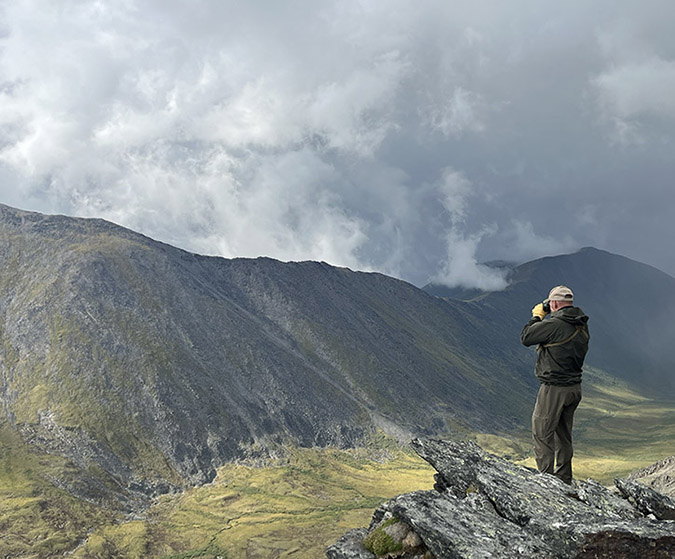
Herd of Dall's sheep seen through a spotting scope in the Yukon       Glassing for rams in the Yukon

Opitz spent 12 grueling days in the Yukon... they saw sheep and rams, just not the mature rams they were looking for.

Habitat Equals Opportunity

If the record book shows what’s happening, people like Glen Landrus, former Wild Sheep Foundation  Chair, can explain why. A lifelong hunter and agricultural educator, Landrus has spent decades watching sheep along the Snake River corridor. When asked why so many giants have appeared lately, he starts with one word: habitat.

“There are a few things at play, and the first is habitat. On the Snake River Corridor, we’ve had kind of a series of summer burns over the last decade or so, and those burns have created lots of high-quality forage out there,” he said. Fire opened escape terrain, reset old brush, and launched new growth. Rams responded almost immediately.

Disease management also played a major role.

In the Washington unit that produced its state-record ram, test-and-remove strategies were implemented early, thereby reducing the number of chronic carriers of Mycoplasma ovipneumoniae. With disease pressure eased, habitat gains finally translated into horn growth. But Landrus is quick to point out it’s easy to focus on the triumphant, inspiring, and important moments of translocations.

“Everybody loves to see that gate swing open, but we can’t transplant our way to a more sustainable population. It also requires habitat work, disease monitoring, and an overall conservation ethic,” Landrus said.
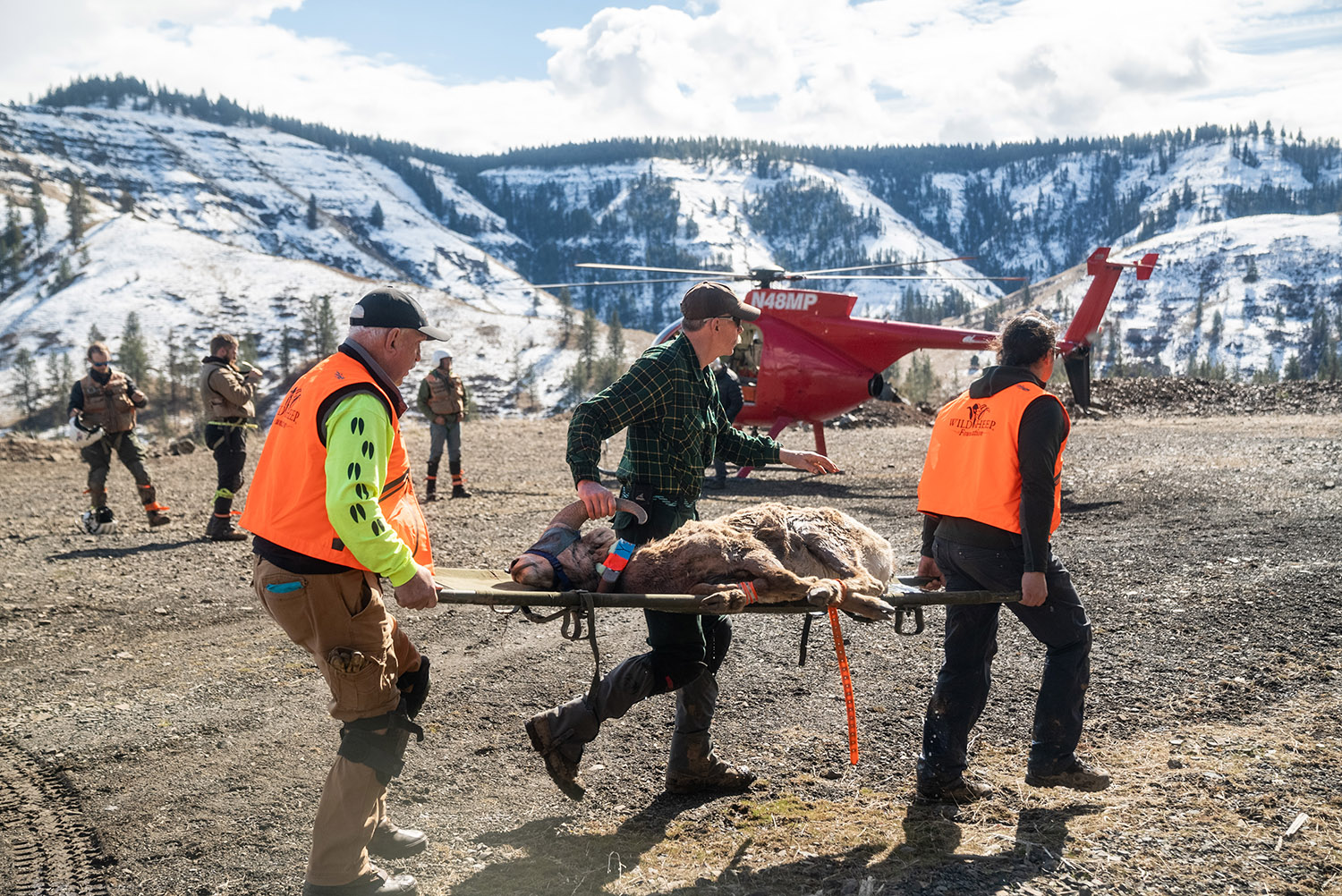
A capture project for the Tri-State Partnership

The WSF Grant-in-Aid Program has helped fund the Tri-State Partnership between Idaho, Oregon, and Washington since 2020. Courtesy Silverline Films.

Landrus said these same principles underpin the Wild Sheep Foundation’s Grant-In-Aid program, which has increasingly focused on landscape-level conservation. Funding prescribed fire, timber thinning, post-burn restoration, and forage improvement as well as managing disease through test and removal aligns perfectly with what Landrus sees in the field: when habitat resets, rams grow big.

He saw this firsthand in New Mexico’s newly opened Rocky Mountain bighorn unit. A massive wildfire scorched the mountain, and when it greened back up, the habitat exploded. Transplanted sheep moved in and thrived. “It’s crazy. Quality habitat, underutilized forage, healthy sheep, and boom, you start seeing these giant rams,” Landrus said.

Back in the Badlands

Back in the eroded clay and broken cliffs of the North Dakota Badlands, all the ideas behind modern sheep conservation: age structure, habitat, selective harvest, and stewardship came together in one deeply personal moment. When Schmitz pulled the trigger and the ram went down, it didn’t feel like a personal conquest. It felt shared. David Suda came down the ridge smiling, not because a record had fallen, but because he had helped a friend experience the same rare miracle he once lived and in doing so embodied the true spirit of sheep hunting.

Suda’s own connection to North Dakota’s sheep is long and deep. He began applying for the once-in-a-lifetime tag at age 13 and eventually drew his tag at 22. He spent six intense weeks scouting for the ram that would become the previous state record. Now he was standing beside the hunter who had surpassed that mark with a ram born of the same canyons, shaped by the same storms, and lifted by the same conservation climb.

Reflecting on it later, Suda remained humble. “I couldn’t be prouder. I’m just very grateful that I’ve gotten the opportunity to be a part of these hunts during these big years,” he said.

He’d watched the herd rebound, watched rams grow older and heavier, and saw conservation work turn into measurable results on the ground. Seeing his friend take a ram of this caliber felt like a continuation of his own story rather than a replacement. To Suda, every great sheep is the product of many hands: hunters, biologists, tribal nations, landowners, and conservation groups all pulling in the same direction. “I’m very, very happy with the North Dakota Game and Fish Department, bighorn sheep biologist Brett Wiedmann,  and everything they are doing for wild sheep. Yeah, there’s some pretty incredible stuff going on out there,” he said.

The Schmitz ram may become a North Dakota record, but the story behind it belongs to all the hunter-conservationists whose expertise, manpower, funding, and ethics have strengthened wild sheep populations across the range of these great animals.

And sometimes that work reveals itself in the simplest of ways, with a ram stepping into view at last light, carrying a lifetime of wildness in its horns and proving what’s possible when conservation is kept in focus.

Badlands Rams

Suda Ram from North Dakota

David Suda with his 2020 Badlands ram.

North Dakota ram

Nick Schmitz with his 197+ Badlands ram.

Bighorn ram in the badlands courtesy Parker Schuster

Badland ram courtesy Parker Schuster.

Contributing Author: Chester Moore is an award-winning wildlife journalist, wildlife photographer, and lifelong hunter from Texas. He operates the Higher Calling Wildlife® blog and podcast and contributes to many outdoors publications.