The episode Brock shared focused on a real conservation challenge unfolding on Wild Horse Island, a rugged island rising from Flathead Lake in Montana. As Marlin Perkins explained in his narration, bighorn sheep had been released on the island decades earlier.
“In many areas of the Rocky Mountains, these handsome, sure-footed animals have, over the years, become low in numbers. Just the opposite is true, however, of the particular herd we’re concerned with today,” he said. The island’s habitat, ideal as it seemed, had limits. Food became scarce. The threat of winter kill loomed. “To prevent this, the excess sheep must be trapped and relocated,” Perkins said.
Viewers watched as wildlife professionals worked patiently and carefully, adapting when plans failed, learning from each attempt, and ultimately succeeding by focusing on smaller groups of ewes.
Each sheep was handled deliberately, placed gently into canvas transport boxes, flown by helicopter to the lake’s edge, and transported to a new habitat on the mainland.
This was, without question, one of the earliest translocations of bighorn sheep broadcast on a national platform. These very kinds of movements of sheep have been supported by WSF, its chapters, and affiliates for decades and have been key to restoring numbers where disease and other threats had eliminated them.
Throughout the episode, Perkins returned to a central idea: conservation is rarely simple, but it is always intentional.
Throughout the episode, Perkins emphasized that the situation on Wild Horse Island was not about spectacle, but about wildlife management, recognizing when animal numbers exceed what the land can support and taking careful, deliberate action to prevent a crisis. Did this dispel the myth that all wildlife can manage itself because it’s in its nature? A lesson many clearly struggle with today.
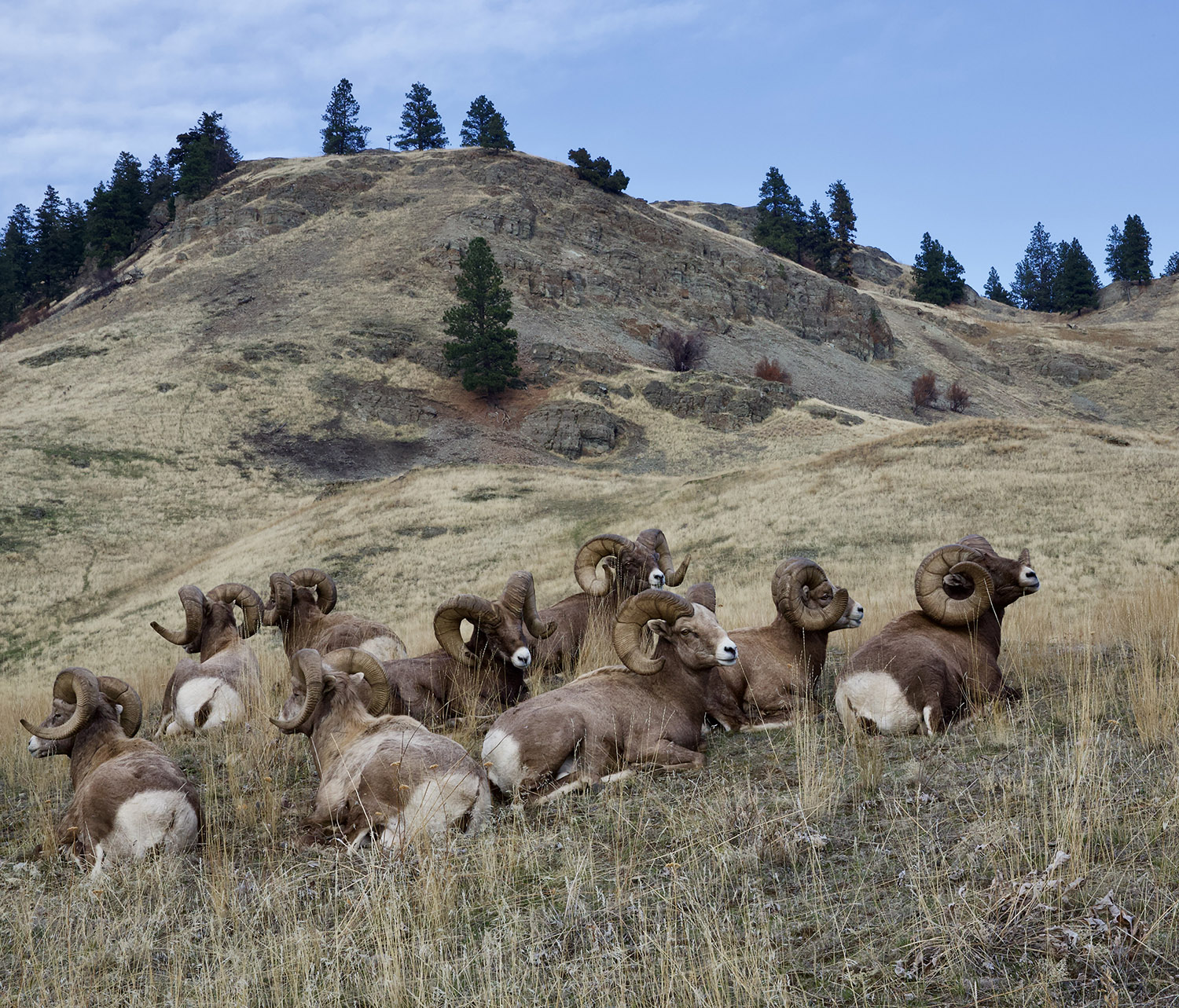
Modern-day herd of bighorn rams on Montana's Wild Horse Island. Courtesy L. Victor Clark.