The results are everywhere if you know where to look.
Elk herds that once struggled now occupy landscapes across the West. Mule deer migration routes are being mapped, protected, and restored. Bighorn sheep, once extirpated in many places, are being captured, relocated, and reestablished on mountain ranges where they have not stood in decades.
Those efforts require years of funding, coordination, and biological oversight. They involve helicopters, biologists, habitat assessment, disease monitoring, aerial surveys, and years of follow-up work. Early Pittman-Robertson restoration efforts helped usher wildlife management into a new era built on science rather than speculation, an approach commonly described as allowing “science to replace guesswork” in wildlife conservation. The act did not simply help restore wildlife populations. It helped professionalize wildlife biology itself.
Before Pittman-Robertson, many states lacked fully staffed wildlife agencies, long-term biological research programs, and professionally trained wildlife managers. Pittman-Robertson funding helped states hire trained biologists, expand wildlife departments, conduct scientific research, and establish wildlife biology as a legitimate long-term profession and career path in the United States.
Much of the scientific infrastructure on which modern wildlife conservation still depends today grew from that foundation.
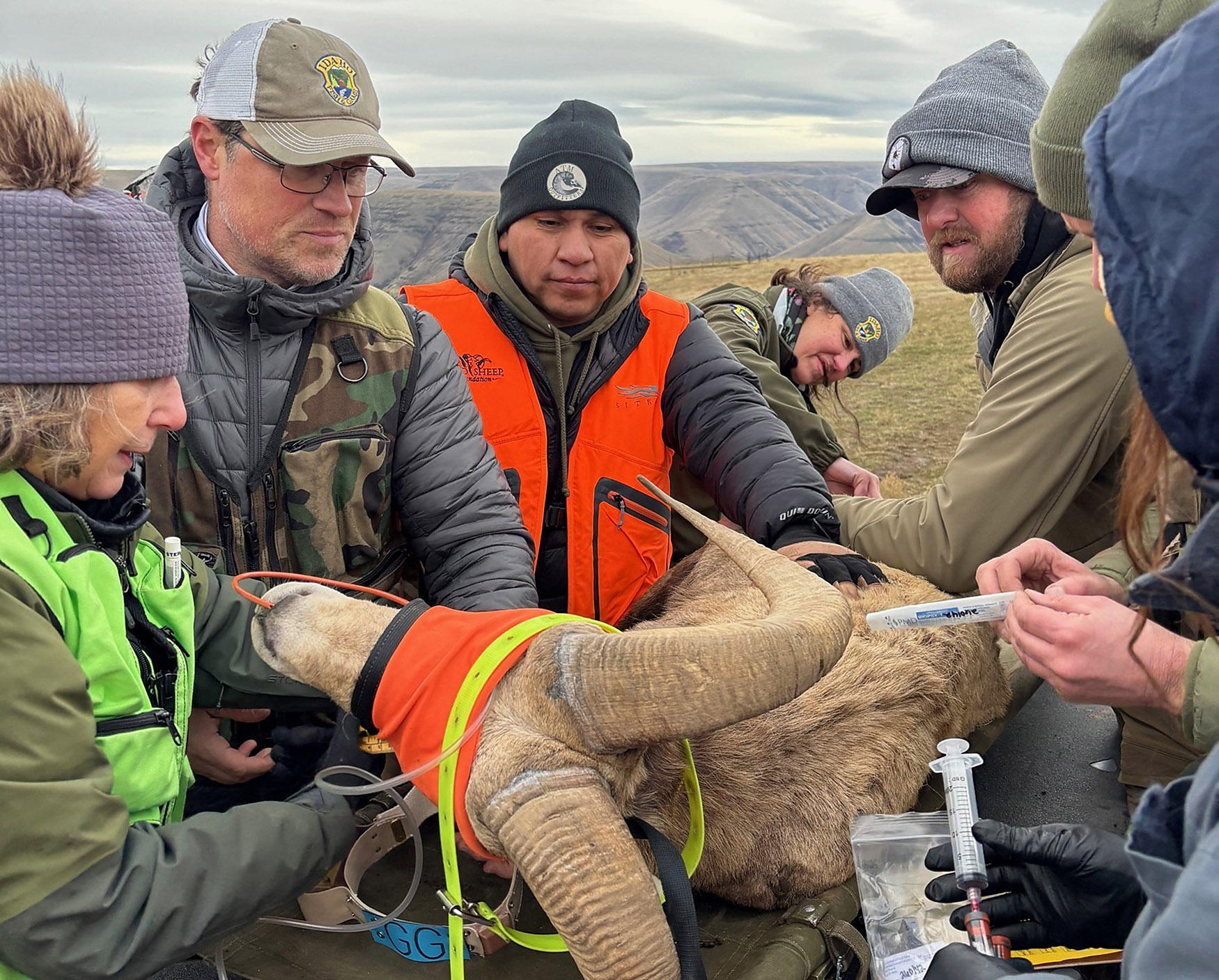
Collecting samples from a California bighorn ram on the Lower John Day River area to test for disease as part of the ION Partnership. Courtesy Kevin Hurley.
The GPS collars tracking migration routes, the disease monitoring protecting wild sheep herds, the aerial surveys guiding population management, the habitat mapping used to place wildlife crossings, and the game wardens protecting wildlife resources all exist today within a conservation system hunters helped build generations ago.
The breadth of this system is not confined to big game in the West. In places like East Texas, eastern wild turkeys, once absent, are returning thanks to ongoing funding of translocations and habitat work. Waterfowl habitat projects restore wetlands for numerous species, prescribed burns improve winter range and grassland health, and migration corridors are mapped and protected across multiple states.
When long-term funding, science, and habitat restoration align, wildlife responds. Wildlife restoration is rarely quick or simple, but over time the results become visible in the landscape in healthier herds, recovered habitat, restored migration routes, and species reclaiming country where they once had disappeared.
Decades before GPS collars, migration mapping, and modern wildlife restoration programs became common, iconic conservationist and wildlife biologist Aldo Leopold described conservation as “a state of harmony between men and land.”
Much of modern wildlife management in North America, including the systems funded through Pittman-Robertson, grew from that same underlying idea: wildlife conservation works best when people remain directly connected to the future of the resource.
Gray N. Thornton, president and CEO of the Wild Sheep Foundation, says such a balance between ecological stewardship and financial value has long been central to the North American conservation model. “Conservation not only serves ecological purposes but also retains significant economic value. The sustainable use of natural resources can support economies while preserving the environment,” Thornton said.
Modern wildlife crossings are one visible example of that larger system at work. They emerge from a larger system that includes wildlife agencies, biologists, transportation departments, tribal nations, conservation organizations, and public funding structures, shaped in part by the North American conservation model itself.
Hunters may not have built every wildlife crossing across the modern West, but they helped build the conservation system behind them. But the North American conservation system was never built solely on government funding.