Parker drew a Nevada antelope tag for a hunt in the fall of 2026. The tag was for antelope with horns shorter than its ears. Suddenly, the lessons in shooting, hunting, safety and field skills had a real-world application. Parker’s father reached out to Brock for some advice. Brock had hunted Nevada's 061 area in the past and was able to share some places to camp and offer some thoughts on how the family might approach the hunt. The family purchased a new rifle for Parker, along with some of the additional equipment needed for a successful hunt, including a rangefinder. Brock then spent an evening with Parker and his dad sighting in the new rifle.
The rifle was ready. The gear was packed. The tag was in hand.
The next day, Parker, his dad and his grandfather loaded up and headed into the Nevada backcountry. Before they left, Brock offered Parker some advice that had less to do with hunting and more to do with enjoying the experience.
“Remember, think of this adventure as a great camping trip where you might be lucky enough to also be bringing meat back.”
It turned out to be advice worth remembering.
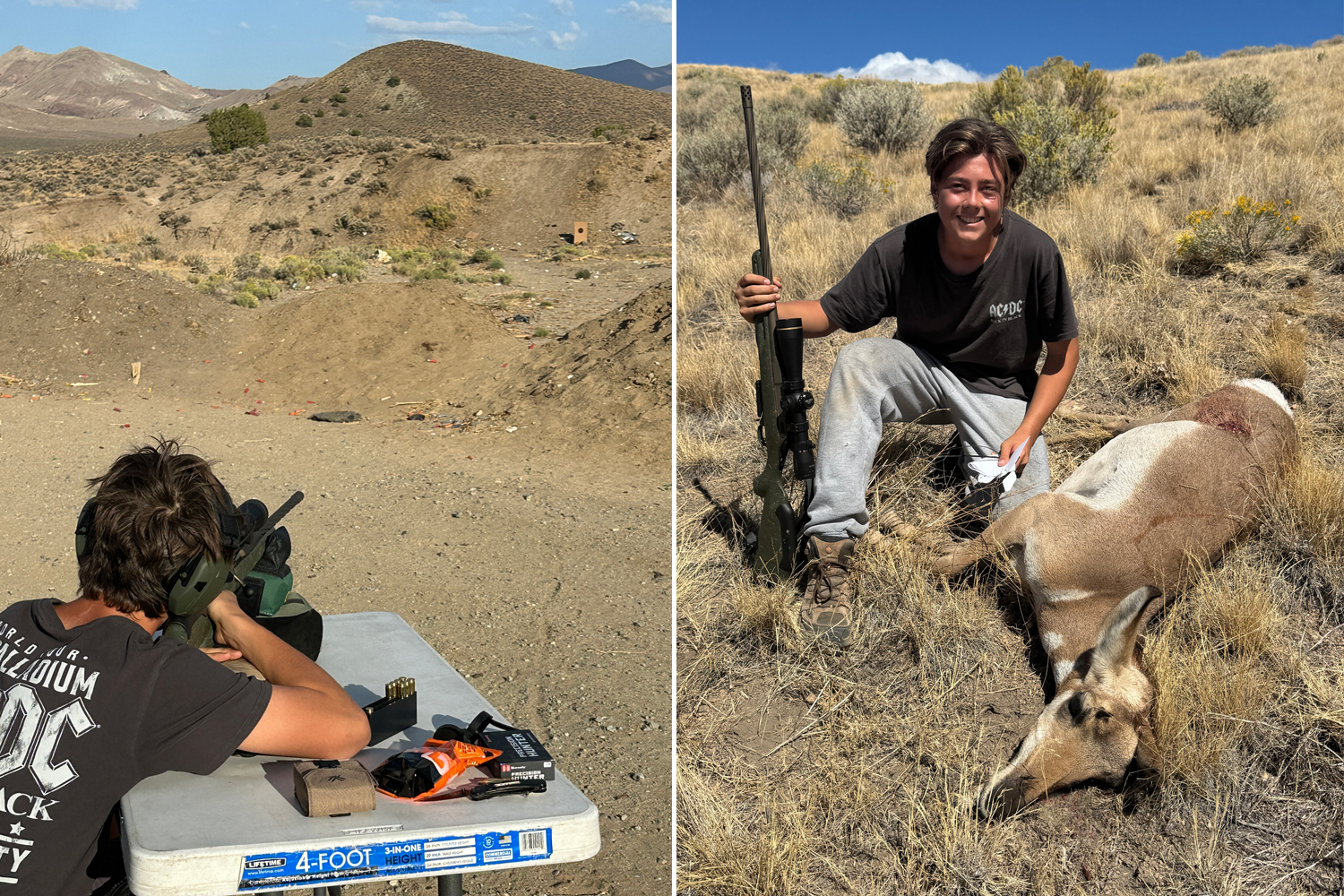
All his hard work sighting in his rifle paid off with a successful antelope hunt.
The first day of the hunt provided plenty of excitement but no harvest. Parker and his family saw two lone male antelope and two herds. One herd was several hundred yards away, and they spent hours trying to close the distance. “We tracked them for about four hours,” Parker recalled, “but we just could not get within 500 yards of them.”
Antelope have a well-earned reputation for being difficult to approach, and Parker was getting his first real lesson in just how challenging a spot-and-stalk hunt could be. The next morning, the family was preparing to leave. They had planned to head back home, but Parker wasn't ready to give up.
“We were going to leave that day, but we hadn't done anything and we didn't really want to go back empty-handed,” Parker said. “So we decided to give it one more shot.” That decision would change the outcome of the trip.
The family spotted another group of antelope and began following them. They hiked up and down the terrain, trying to position themselves for a shot. Eventually, they found the animals across a series of ravines. Parker had an opportunity, but the shot was a difficult one—about 350 yards, with a steep incline. He fired three times and missed. Rather than being discouraged, Parker understood the difficulty of what he had attempted.
“I'm not too upset that I missed those,” he said. The family returned to the vehicle, but instead of calling it a hunt, they decided to make one final effort. Other hunters they came across had told them that the area held several groups of antelope in another location, so they moved and began looking again.
They found another group. This time, Parker and his family were able to track the animals for about half an hour and eventually get into a good position. Parker took the shot. And this time, he was successful. His first big-game animal was down.
For Parker, the excitement of the successful hunt was only part of the experience. He and his dad were now faced with another part of hunting that neither had done before: field dressing and processing a big-game animal. “It was difficult,” Parker admitted. “It was pretty hard.”
There were some mistakes along the way, including nicking the guts while working on the animal. The family also discovered just how quickly a knife can become dull when you're processing an animal. But they worked through it.
“It was hot, and I think it took a lot longer than it should have,” Parker said. “But we got the meat out.” The antelope was packed into game bags and carried back to the vehicle, where it was placed in coolers. The family later took the meat to a butcher, where they received the good news that the meat was in excellent condition.
The hunt had produced more than a photograph. Parker had successfully taken an animal, learned how to process it and was bringing home meat that his family could eat. Yet when asked what his favorite part of the experience was, the hunt certainly came up. But so did something else. He talked about being outside. “I liked just being out there,” he said.
Away from Reno's lights, Parker discovered another part of the outdoors that he hadn't fully appreciated like he had on this hunt. “When we were out there, there was like nothing,” he said. “You could kind of see the Milky Way, which was really nice.” He spent about 15 minutes simply looking at the stars.
For a young man who had started his outdoor journey by picking up a bow at an after-school archery clinic, that moment seemed fitting. S.H.E.E.P. is about more than teaching young people how to shoot a bow or safely handle a firearm. It is about providing opportunities—opportunities to learn, to try something new, to spend time outdoors and, eventually, to experience the responsibilities that come with hunting. Parker's path illustrates how those opportunities can build upon one another.
A fifth-grade archery clinic led to an archery team. The archery experience sparked an interest in hunting. A pig and fishing trip provided Parker with his first taste of hunting, even though he didn't harvest an animal. Hunter education and a Learn to Hunt clinic provided additional skills and knowledge. And eventually, a Nevada antelope tag gave him the opportunity to put all of those lessons together. His first hunt may not have gone exactly as planned. His first three shots at an antelope didn't connect. Cleaning his first big-game animal wasn't easy. But Parker kept learning, kept trying and ultimately accomplished what he had set out to do.
And perhaps most importantly, he discovered that the reward of a hunt isn't always measured by what comes home in the cooler. Sometimes, it's the people you're with, the lessons you learn, the challenge of the pursuit—and 15 quiet minutes beneath a Nevada sky, looking up at the Milky Way.
The Wild Sheep Foundation's Shooting, Hunting, and Ethics Education Program (S.H.E.E.P.) is exciting and inspiring the next generation of outdoor enthusiasts and wildlife conservationists.
Learn more about upcoming S.H.E.E.P events and the free Wild Sheep Teachers Kit.
Learn More