I wish I knew then what I know now. It would have changed everything. But most likely, without everything that happened, I would have never pushed myself to go one step further. As we kept climbing higher, I peeked over my bow riser to read a note my wife had written there: “Never more prepared than today. Love you. Victoria.”
We all organize hunts for different reasons. For some, it’s about collecting species. For others, discovering new places and countries, disconnecting from everyday life, spending time with friends and family, chasing adventure, or maybe even recognition. A bit of all that is probably involved in my planning too, but the thing that truly excites me, the thing that keeps me awake at night, is trying to challenge myself to do something I’m not sure I’ll be able to accomplish.
Back in 2022, driving along the Issyk-Kul Lake in Kyrgyzstan, I could already feel the excitement of the adventure ahead. Trying to hunt a Marco Polo sheep with a bow was the biggest challenge I had ever attempted, and my stomach was tight, partly from the elevation of the road, but most likely from the fear of not being able to pull it off.
A last-minute change of plans landed us in a camp that wasn’t unfamiliar to me. I had actually been there before, back in 2010. That trip was probably the worst hunt I’ve ever experienced, and the only one I’ve ever left early because of the disgusting poaching activities of the guides.
Among other things, they offered me the chance to shoot a Marco Polo for free, just to take a photo with it afterward. My answer was clear. If I didn’t have the means to properly afford the most beautiful sheep on the planet, I wasn’t going to shoot it just for a picture and leave it there. Animals deserve far better than that.
The guide got furious, grabbed my rifle, and fired into the middle of a group of Marco Polos, killing a young ram to prove...I’m still not sure what. At that moment, I jumped on my horse and rode back alone, promising myself I would never return.
But time has a way of softening things, and ten years later I decided to come back, this time with a sheep tag in my pocket. What I definitely wasn’t expecting was that, in a country this big, I would end up in the exact same camp under the same manager from 2010, bringing back to life a lot of memories I thought I had buried.
The name Marco Polo comes from the Venetian explorer and writer who traveled the Silk Road more than 700 years ago. In his writings, he described sightings of wild sheep with massive horns roaming these high valleys. These argali can be found in both Tajikistan and Kyrgyzstan, with several different subspecies. We were actually hunting near the Naryn River, the boundary between two of them: the Tian Shan argali and the Pamir. Depending on the day and whether we crossed the river with the horses, we would technically be hunting one or the other, so for simplicity I’ll refer to all of them as Marco Polo.
The reason I chose Kyrgyzstan was mainly because of the style of hunting. For me, that matters more than the species itself. Here, hunts are typically done on horseback, sleeping in fly camps or small huts high in the mountains, and that is exactly the kind of adventure that excites me. A true mountain hunt.
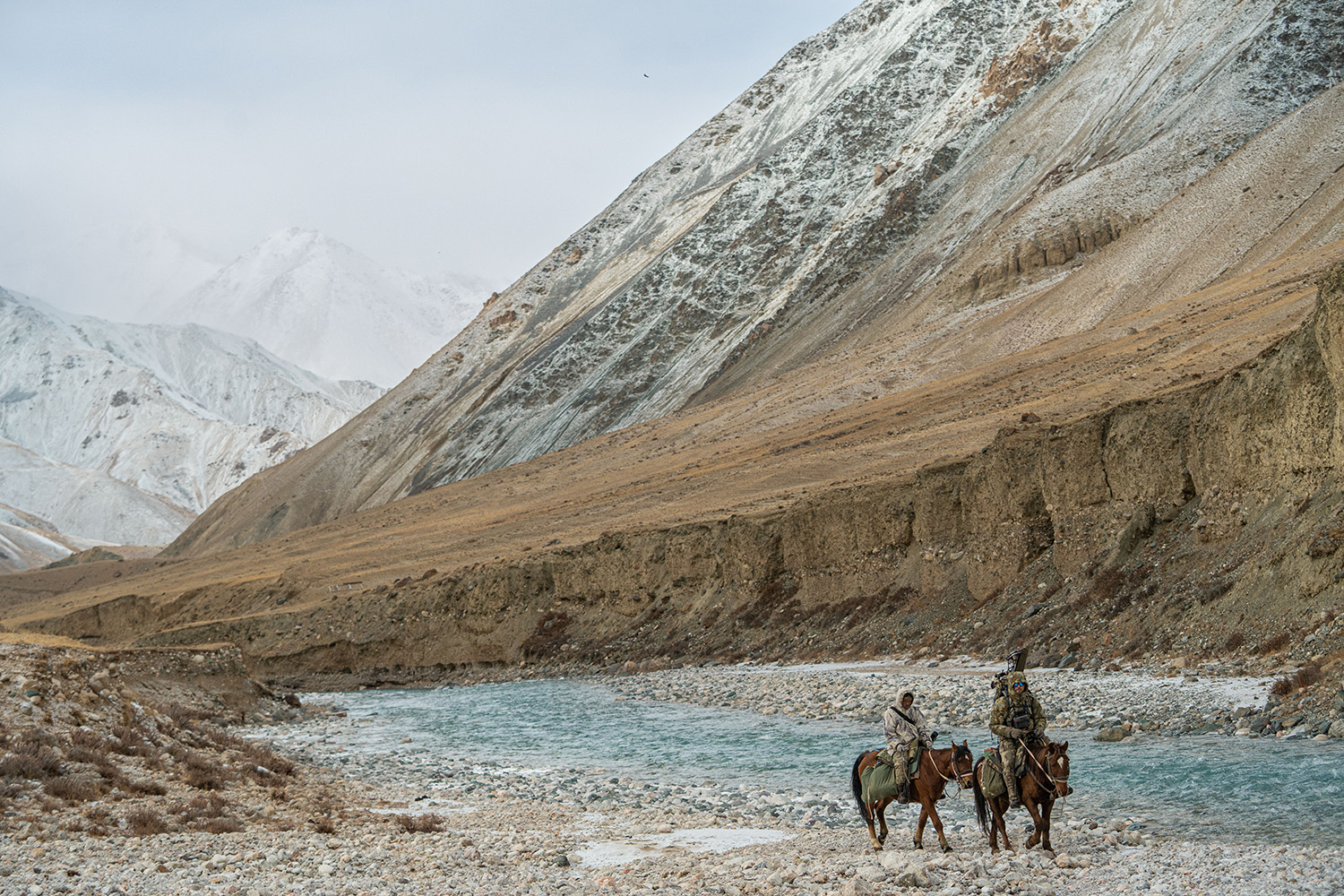
The author riding through the Kyrgyzstan mountains in 2022.
I’m used to bowhunting in places where people have never seen a bow before, so it didn’t surprise me that it took several days to get the team and the hunting system dialed in. Normally, I let guides hunt their way at first and slowly make suggestions when things aren’t working.
I started the hunt with a translator, a cook, a game officer, three guides, and another man handling the horses. Add my cameraman and myself to that and imagine the amount of noise and movement involved.
For stalking, they always tried to have several guides physically lead you by the hand. They believed pushing or driving animals was the best tactic. But after several days, I managed to trim the team down to only two guides. I didn’t need a translator or a cook, and eventually I gained their trust enough for them to allow me to do the final stalks by myself.
One of the biggest challenges here compared to other mountain game we’ve hunted with a bow is that, unlike ibex and other Capra species, sheep live in much more open and rolling country. During the rut, groups can range anywhere from twenty to over a hundred animals, and among all of them only a few are mature rams.
You need to get close to a huge group, identify the old ram, range the distance, adjust the sight, wait for the perfect broadside angle, and execute a very long and technical shot under enormous pressure. On top of that, you’re trying to capture everything on video.
To be honest, I didn’t fully understand the magnitude of the challenge until we had spent an entire week there without a single opportunity.
Finally, after seven days, we located a group of rams in what looked like a “stalkable” position. My cameraman and I slipped down the mountain and got as close as possible using the almost nonexistent vegetation for cover. When one of the rams stood up from its bed, we couldn’t move any closer. I ranged the distance, adjusted the sight, drew back, and took a deep breath. It was an extremely long shot, but I felt confident. The moment I released, I knew my dream was over. I heard the string hit one of my jackets and saw the arrow fishtailing as it left the bow. At long distances, losing just a little speed is enough to completely miss an animal, and that’s exactly what happened.
We hunted hard but didn’t get another opportunity until day eleven. It took us the entire day to get within range of two rams, and as the sun was setting and my hands were freezing, I took another very long shot. This time, the arrow flew right over the ram’s back.
The pressure of trying to shoot a ram on the last evening of the final day after eleven days of grinding through the mountains was enormous. Honestly, making it happen would almost have felt too good to be true. I had opportunities, but I couldn’t close the deal. I was deeply disappointed, but at the same time we had proven that our dream was possible. And if there’s one thing we are truly good at, it’s not giving up. So I flew back home for a couple of weeks to reset, recover, and figure out how to properly shoot at extreme elevations.
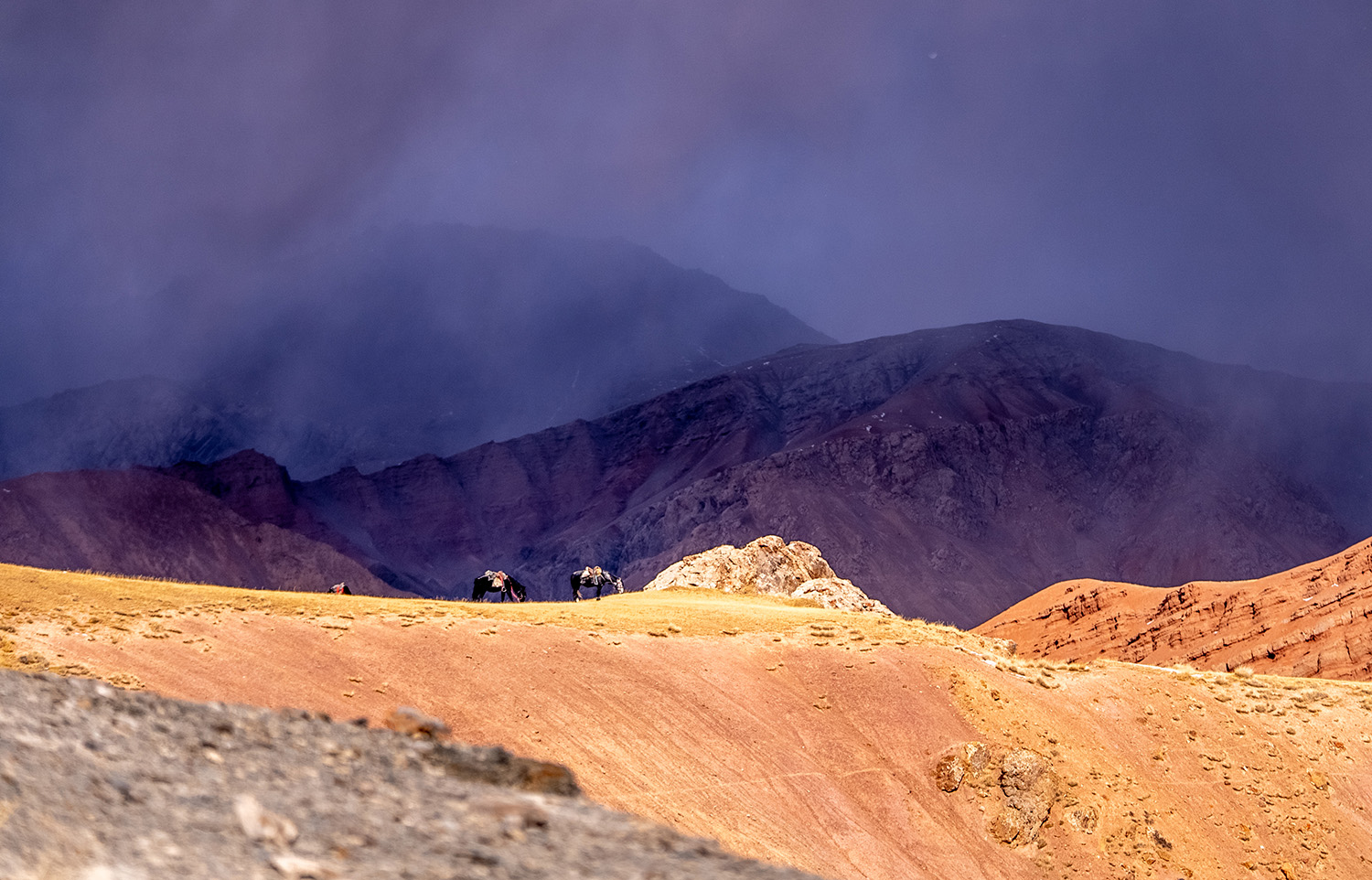
At this elevation, even the horses struggle to survive.
I genuinely believe that was part of the problem. On shots beyond 100 yards, the difference in air density between sea level back home and 13,000 feet in Kyrgyzstan is massive. Despite re-sighting the bow in camp and trying several adjustments, I still hadn’t figured out the solution.
Right before the season ended, at the end of November that same year, I returned for a second attempt. I was hopeful because we had learned a lot during the first trip, but when I arrived and discovered the outfitter had changed all my guides and even my hunting area, I knew we weren’t off to a good start. All the work from the previous trip went down the drain. We had to start from zero again. Things started falling apart almost immediately. After only one day, the main guide quit.
He kept insisting that I should use a rifle, and I think the hunting industry has become such a business that some guides no longer understand that I wasn’t there simply to bring home a trophy. I was there because I love the challenge of stalking difficult animals and spending time in the mountains. That’s why I chose a bow, and I wasn’t going to change that.
I understand that bowhunters are probably not the most profitable clients for an outfitter, but they knew from the beginning that I was committed to taking one with a bow or not taking one at all. One problem led to the next. They used our ibex permit, nobody wanted to guide us, our guides abandoned us while returning to camp, and to top it all off, my cameraman Lewis developed severe pulmonary edema due to the high elevation and could barely breathe.
I tried my best to hunt and document everything myself, but it just wasn’t happening. My head was in too many places at once, and there was so much going on that I stopped enjoying the peace and freedom these mountain hunts usually give me.
For the second time, I flew back home empty handed.