
Originally published in Conservation Impact Fiscal Year 2024-2025
C&A Partners: Sonoran Wildlife Foundation
Deep in the shadows of a limestone cave in Sonora’s Sierra El Álamo, a desert bighorn ewe waited out the midday heat. For researchers reviewing video collar footage, it was an intriguing insight into how sheep cope with the desert’s extremes.
“One of the biggest surprises of our research is just how much the sheep used caves,” said Dylan Stewart, a Texas A&M Ph.D. student whose dissertation focuses on Sierra El Álamo sheep ecology.
“We started noticing GPS data gaps at midday in summer, and when we paired that with video footage, we realized those missing fixes were happening when sheep were moving into caves. That’s when it clicked that these weren’t random losses, they were animals finding thermal refuges underground.”
The discovery stemmed from a Wild Sheep Foundation (WSF) Grant-In-Aid project that supported refurbishing GPS collars and outfitting desert bighorns with video collars. These tools allowed researchers to follow movements in near real-time while capturing daily behaviors.
“We can now receive GPS locations twice a day and pair those with the video footage from an attached camera that films for 15 seconds three times daily,” said Stephen Webb, research scientist with Texas A&M University, and Stewart’s Ph.D. adviser.
“That combination tells us not just where the sheep are, but what they’re doing and whether they’re feeding, bedding, or seeking shade in caves.”
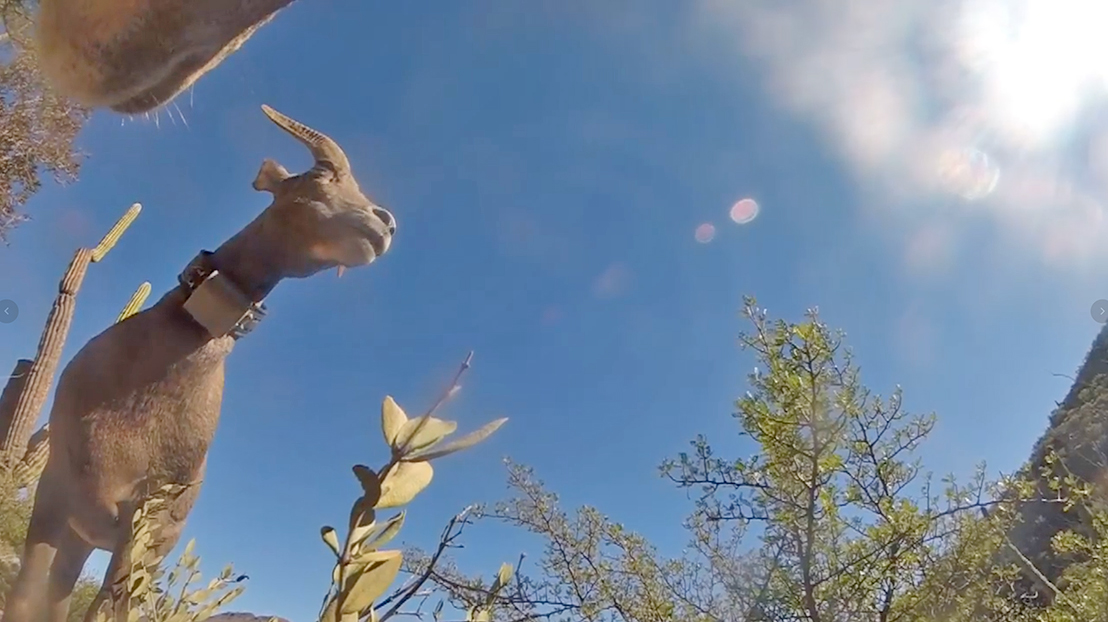
GPS collars with video capabilities were attached to the sheep giving researchers valuable data on movement and behavior.
The collars are helping answer questions central to desert bighorn recovery: how well translocated sheep adapt, what habitats they select, how and where they disperse, and how limited water can be best distributed.
Data shows that rather than wandering aimlessly after release, Sierra El Álamo sheep quickly integrate with resident herds, giving managers a clearer picture of group dynamics and habitat use.
Sierra El Álamo spans more than 27,000 hectares (around 67,000 acres) and has become one of Mexico’s key desert bighorn restoration areas. Since 2017, the Artee family, local landowners, have overseen releases and invested heavily in catchments and drinkers across their property. By the end of this fall, more than 300 sheep will have been released into free range, securing the range’s role as a cornerstone of Sonoran restoration.
“These sheep are telling us where the best water catchments are, how far they’ll travel, and what features matter most,” Webb said. “That’s information managers can apply everywhere from Nevada to Coahuila.”
Water availability is central in management decisions. Placing catchments where sheep can access them efficiently helps conserve energy and avoid heat stress. Still, managers must weigh trade-offs such as terrain, distance, and predator exposure. Understanding these dynamics will guide even better design and placement for desert bighorns.
“Every collar, every data point and every video snippet are pieces of a bigger puzzle,” Stewart said.
In a region where poaching and habitat loss once drove desert bighorns to the brink, the image of a ewe stepping from a cave to drink at a catchment is a harbinger of a good future for her kind Southwest-wide.
The lessons from Sierra El Álamo may ripple far beyond Sonora, showing how science, landowners, and hunters together can map a future where desert bighorn sheep reclaim their rightful place on Mexico’s mountains and beyond.
Tags: Desert Bighorn, Grant-in-Aid, Conservation