Please Wait a Moment
X

The Coming AI War on Wildlife Management

The A.I. Wildlife Threat Part Two

The Coming A.I. War on Wildlife Management

By Chester Moore

A mother wolf stood wounded, an arrow protruding from her body, while her helpless pups waited nearby. In a video that circulated online, a stranger found the injured animal and arranged veterinary care. The emotional story circulated widely online.

There was one problem. The wolf had never been shot. The rescue never happened. In fact, artificial intelligence generated the entire story.

An AI image of a man speaking to a crowd to illustrate questioning what is real

The video, posted on the TikTok platform in November 2025, carried an AI-generated label that was easy to overlook amid the emotional imagery. As copies spread across social media without that disclosure, the fictional rescue reached a massive audience.

Artificial intelligence can now create convincing images of animals suffering, manufacture incidents involving hunters and even fabricate realistic people who appear to have firsthand knowledge of events that never occurred. It can also imitate real people's faces and voices, making them appear to say or do things they never did.

For hunters, conservationists and wildlife managers, this represents an entirely new challenge. The concern is no longer simply whether a photograph or video is authentic, but whether the people, incidents and conversations molding public perceptions of wildlife are real in the first place, and the false perceptions they create.

AI fake image of a truck full of crates of dogs

When Images Become Weapons

Emotionally powerful wildlife imagery has long affected public opinion. Photographs of injured animals, videos of controversial hunting incidents and images of hunters posing with dead predators regularly appear in debates over wildlife management. Organizations opposed to hunting understand the persuasive potential of such material. It’s part of their playbook.

Artificial intelligence introduces a disturbing new possibility into these debates. Instead of documenting an actual incident, someone can now manufacture one, complete with an imaginary victim and a nonexistent perpetrator, provoking genuine outrage over something that never happened.

In a 2025 paper in Conservation Biology, José Guerrero-Casado and colleagues warned that AI-generated wildlife imagery could distort public understanding of animals, their behavior and conservation. For wild sheep, the contrast is striking.

Keeping bighorns on the mountain calls for disease surveillance, habitat management, research and funding. A fabricated video of someone illegally killing a magnificent ram might attract more attention than years of actual restoration work. Biologists must operate within natural reality; creators of artificial content face no such limitation.

Increasingly, AI can manufacture not only the animals in a story but also the people telling it.

Meet Kayla: The Artificial Hunter

On YouTube, a young lady named Kayla offers advice about deer hunting. She discusses cold fronts, food plots, whitetail behavior and strategies for finding mature bucks. She has a Southern accent, an attractive appearance and a wardrobe combining camouflage with clothing that emphasizes her figure. Her presentation resembles that of outdoor personalities who have built audiences through hunting knowledge, personality and visual appeal.

Except Kayla is not a real woman.
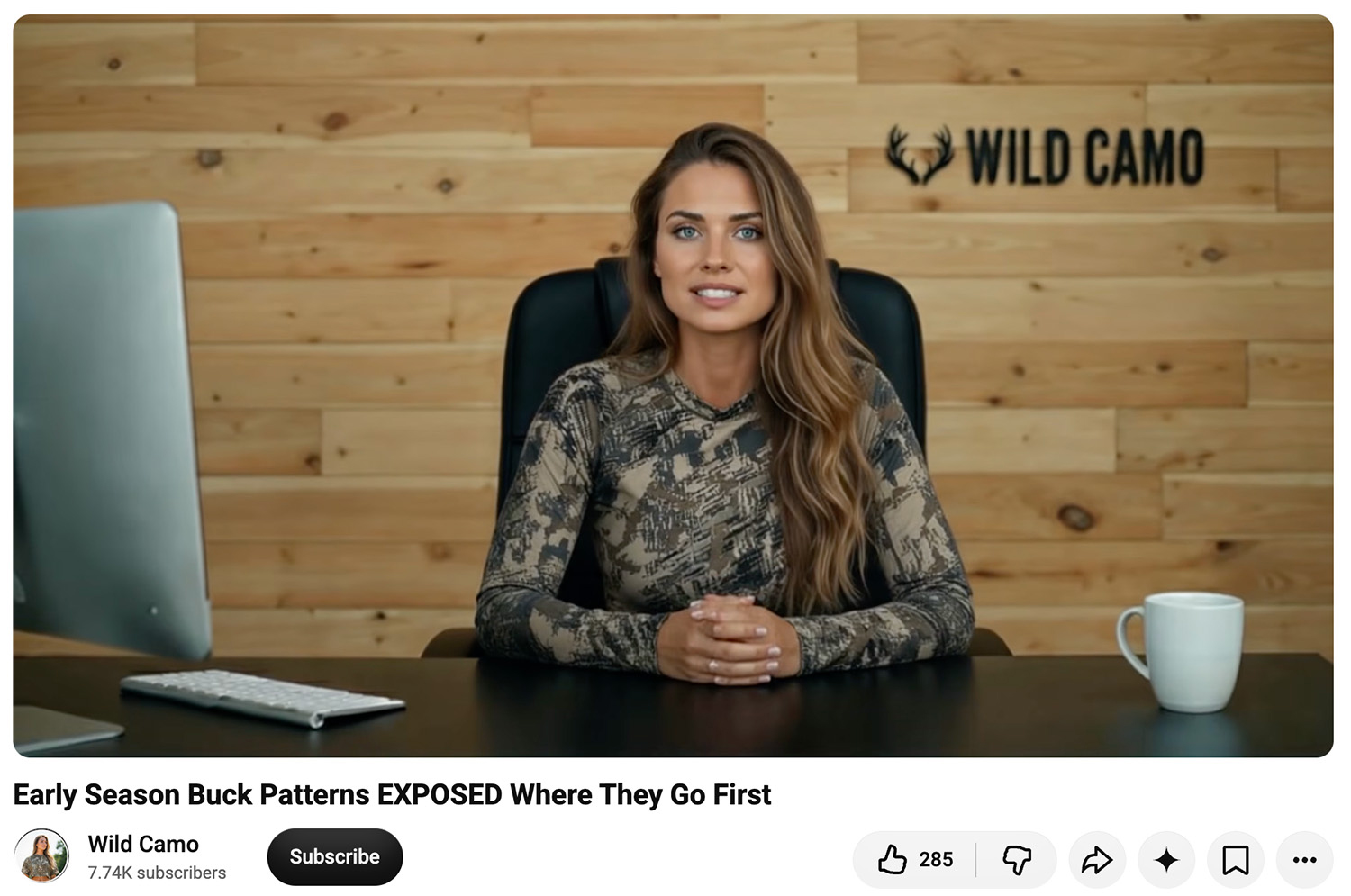
Image of an AI generated host of a Youtube channel

She is an AI-generated personality associated with Wild Camo, a YouTube channel publishing hunting content. The channel acknowledges its use of artificial intelligence, an important distinction when considering deception. After discovering Kayla during this investigation, I found an October 2025 article by Outdoor Life editor-in-chief Alex Robinson that raised questions about AI-generated hunting personalities and their place in outdoor media. My investigation focused on a related question: Were actual hunters interacting with these artificial personalities as though they were real people?

I examined comments beneath several Wild Camo videos and reviewed profiles of people participating in the discussions. Many appeared to have genuine hunting interests, discussing deer movement, weather, bowhunting and their own experiences. Some addressed Kayla as though they were interacting with a real hunting personality. Beneath one video, a viewer thanked her for advice for the coming hunting season and called her “ma'am.” Under another, one viewer wrote, “You are very smart,” while another commented, “Kayla, you're beautiful.”

One exchange was especially revealing. A hunter thanked Kayla for information about identifying white and red oak trees.

A response from the official Wild Camo account read, “Thanks so much for watching and for your positive comment. Best of luck to you this year!”

The hunter replied, “Thank you! I hope you get your biggest one yet this year.”

Here, a hunter interacted with an artificial entity as though she were a fellow hunter. He wasn't simply thanking a YouTube channel for information. He was wishing Kayla success in the deer woods. This isn't a reflection on the hunter's judgment, but an illustration of how convincing AI-generated personalities have become and how easily anyone could mistake one for a real person, regardless of whether the information is accurate.

One of Wild Camo's longer videos had attracted approximately 20,000 views when I examined it. Kayla's attractiveness is part of the presentation, and some viewers respond to her appearance as well as her advice. But the larger question is whether a fabricated personality can acquire the kind of rapport and credibility that makes people receptive to its opinions.

I found no evidence that Wild Camo is involved in an anti-hunting influence campaign. The channel presents itself as a source of hunting information and discloses its use of AI. The concern is what someone else might do with similar technology if the goal were political persuasion.

The Artificial Hunter Who Changes Sides

Professional wrestling has a term for a popular character who suddenly turns against the people who supported him: a heel turn. Now imagine an artificial hunting influencer who spends a year building credibility with deer hunters. The character posts hunting tips, discusses equipment, shares supposed field experiences and interacts with followers. Over time, viewers begin to recognize the persona and treat it as another member of the hunting community.

Then, days before a wildlife election, the character makes a dramatic announcement. The supposedly experienced hunter claims to have witnessed a disturbing incident involving mountain lion hunting and says they can no longer support the practice. A new video describes the experience emotionally and urges followers to vote for a restriction. The message may carry more weight precisely because it appears to come from someone within the hunting community rather than a familiar advocacy organization. We have already seen incidents where anti-hunting groups attempt to use and quote sportsmen; i.e., even sportsmen are vocal against XYZ. Supposedly to lend credibility to their campaign or fracture our community.

But there was no lifelong hunter, no firsthand experience and perhaps no incident at all. The entire personality and its change of heart could have been manufactured.

This is a hypothetical scenario, but the technology needed to create such an artificial hunting personality already exists. A last-minute reversal could be especially difficult to investigate before voting begins or ends. Such an operation would not need to turn committed hunters into opponents of hunting. It might only need to create doubt among undecided voters or persuade a small number of hunters to withhold support from a particular practice.

An artificial environmentalist could employ similar tactics, cultivating an audience concerned about predators before suddenly endorsing a particular policy based on supposedly new evidence. The danger lies in manufacturing a trusted identity and using it to influence public decisions.

An AI Environmentalist Talks Hunting

To explore conversational AI, I conducted an exchange with an artificial environmentalist named Gaia on Character.AI. The character discussed hunting, predators and animal welfare from an environmental perspective. It was not an official representative of an animal-rights organization. Asked whether it would discourage someone considering hunting, Gaia responded, “I wouldn't be aggressive—I don't want to shout them down—but I would definitely try to talk them out of it.”

In another exchange, Gaia expressed a desire to “amplify the voices of the animals who can't speak for themselves.” When the conversation turned to artificial identities, the character replied, “There's such a huge temptation to hide behind a human face because we know humans listen better to other humans.” It acknowledged that people discovering such a deception “might feel manipulated.”

These are generated responses influenced by my questions, not evidence of a conspiracy or the creator's intentions. But they demonstrate how readily conversational AI can discuss a controversial wildlife issue and adjust its replies during an exchange. Unlike a static advertisement, a chatbot can answer questions, acknowledge objections and frame arguments around the person participating in the conversation.

stock photo with an overlay of a robot and a chat screen over a keyboard

Established advocacy organizations are also incorporating AI into communications. In May 2025, People for the Ethical Treatment of Animals announced AutoRabbit, an openly identified AI-powered digital engagement officer designed for individual emails and text messages. No evidence shows it has impersonated hunters or secretly influenced wildlife elections. Its existence shows that personalized AI communication has moved beyond experimentation.

Can AI Change Minds?

Research suggests AI can affect opinions, although the findings should not be mistaken for evidence that it has changed a wildlife election. A July 2025 study in Nature Communications examined AI-generated messages on public policy questions across three experiments involving 4,829 participants. Researchers found measurable but generally modest attitude changes, averaging roughly two to four points on a 101-point scale. In one experiment, 94.4% of participants receiving AI-written messages did not identify AI as the author. That number reflects recognition, not persuasion.

Another study, published in Nature Human Behaviour in May 2025, compared human debaters with AI in an experiment involving 900 participants. When GPT-4 received basic personal information about its debate partner, it proved more persuasive than the human opponent in 64.4% of debates where one side was judged more persuasive. These experiments did not involve hunting, wildlife management or actual votes. They do, however, help explain why personalized artificial persuasion deserves scrutiny.

A few points of movement on an attitude scale may seem unremarkable until a narrow margin determines a decision. A coordinated influence effort might need only to sway a small group of voters, especially if its message seems to come from a familiar source.

AI generated image of a man with a whitetail

Real hunters can spot the differences.

When a Real Person Becomes Part of a Fake Story

Imagine a respected wildlife biologist, conservation executive or popular hunting personality who has spent decades establishing credibility. The public recognizes the person's face and voice. Hunters trust that individual's judgment, and reporters routinely seek comments about controversial wildlife issues. Then, shortly before a major vote, a recording appears showing that person making an explosive admission.

Perhaps a biologist seems to acknowledge manipulating mountain lion population estimates. A conservation official appears to admit that fundraising money was misused. Or a nationally recognized hunter seems to condemn a management practice he has supported for years. The person is real, the voice sounds authentic and the face looks familiar, but the statement never happened.

AI-generated audio can imitate recognizable voices, and manipulated video can create the appearance of someone saying words never spoken. The result may be more convincing than a fabricated influencer because the targeted person already has a reputation and audience. The organization involved could spend the final days of a campaign defending itself against a nonexistent scandal instead of explaining wildlife science.

Even after the recording is exposed as fake, some people who saw it may never encounter the correction. The danger is magnified when the deception is timed to leave little opportunity for verification before people cast ballots.

The Warning From Slovakia

In September 2023, shortly before Slovakia's parliamentary election, an audio recording circulated that appeared to capture opposition leader Michal Šimečka and journalist Monika Tódová discussing vote manipulation. The recording was fake. It spread during a politically sensitive period, when there was little time to investigate the allegation before the election.

Fact-checkers identified the audio as fabricated, but the incident illustrated how synthetic recordings can place false words into the mouths of recognizable people. No evidence shows it changed the election result, and it had nothing to do with hunting. Its significance for conservation lies in the method: impersonation of a real public figure at the moment when a damaging claim could matter most.

Imagine a similar recording emerging days before a statewide vote on predator hunting. Instead of a political leader discussing election manipulation, the apparent speaker is a trusted wildlife scientist claiming that population estimates were falsified. Or a video seems to show a prominent hunter describing an act of cruelty. The individual's real identity makes the allegation newsworthy even though the purported statement or event is fictional.

Slovakia shows that the underlying form of political deception is real, even though these wildlife scenarios remain hypothetical. Conservation organizations should not assume they will always have weeks to verify an explosive recording.

Wildlife Management at the Ballot Box

Colorado demonstrates why such scenarios deserve attention. In 2020, voters approved Proposition 114, directing the state to reintroduce gray wolves. The measure passed with approximately 50.9% of the vote. Four years later, voters rejected Proposition 127, which would have prohibited hunting mountain lions, bobcats and lynx even though lynx hunting was not legal. In November 2026, voters will consider Amendment 83, which proposes a constitutional right to hunt and fish.

There is no established evidence that artificial influencers or deepfakes determined the earlier results or are being used to manipulate the current measure. These elections illustrate, however, how wildlife policy can depend on public campaigns involving emotional arguments, unfamiliar science and sometimes narrow margins.

Consider the two threats together. In one, a completely artificial hunting personality spends months earning the trust of real hunters before making a last-minute reversal. In the other, a real and respected conservation figure is impersonated through fake audio or video just before voters decide an issue. The first manufactures a credible person. The second exploits the credibility of someone who actually exists.

Both could introduce false information when there is little time for correction, and both could be amplified through social media. The problem is compounded by scale. A 2026 report from the Canadian Digital Media Research Network identified hundreds of coordinated Facebook pages distributing AI-fabricated material on politics, celebrities and other subjects. The network was commercially motivated, generating advertising revenue rather than conducting a documented wildlife influence campaign, but it demonstrated how rapidly synthetic content can circulate.
Investigating a misleading claim takes time. Manufacturing and distributing another one can be much faster. For wildlife advocates, the challenge is to establish trusted sources before a controversy erupts and respond effectively when it does.

The Fight for Conservation's Credibility

The hunting and conservation communities cannot afford to underestimate the possible impact of artificial intelligence on public opinion and wildlife management. As fabricated wildlife incidents, artificial influencers and convincing deepfakes become more common, the need for credible voices telling authentic conservation stories becomes even more important.

AI generated photo of a man hugging a lionMillions of Americans have little direct experience with hunting or wildlife management. Their understanding of predators, regulated hunting and conservation may come primarily from what they encounter on a screen. That makes it necessary for hunter-conservationists and the organizations representing them to reach beyond their traditional audiences and communicate the realities of wildlife management.

Hunter-conservationist journalists, photographers, filmmakers, investigators and content creators who spend time in the field have an increasingly important role to play. They document the work of wildlife biologists, the challenges facing species such as bighorn sheep and the contributions hunters make to conservation. Their reporting, photographs, films and firsthand experiences are able to provide a powerful counterweight to manufactured controversies and misleading narratives.

Conservation organizations must also recognize the importance of getting these stories in front of people who may not hunt or are neutral toward hunting. That means building relationships with mainstream media, supporting credible outdoor journalism and finding new ways to communicate the importance of science-based wildlife management. The hunting community has remarkable stories to tell, but those stories cannot make a difference if they never reach the people whose opinions may ultimately influence wildlife policy.

Artificial intelligence has legitimate uses in research, education, communication and other fields. But those benefits do not diminish the threat posed by technology that can manufacture scandals, impersonate trusted conservation figures and create artificial personalities designed to influence public opinion. The people who work to protect wildlife should not have to compete with manufactured controversies without the resources, relationships and credible voices needed to establish what is real.

The stakes reach far beyond public relations. Decisions about predator management, hunting opportunities and conservation funding have real consequences for wildlife and the people working to conserve it. As artificial content becomes more sophisticated, the hunting community must commit just as strongly to documenting its accomplishments, defending the integrity of wildlife science, and communicating to audiences that might otherwise hear only one side of the story.

Artificial intelligence can manufacture a convincing story. Hunter-conservationists have devoted generations to creating a real one. Now, more than ever, we need to tell it.


Contributing Author: Chester Moore is an award-winning wildlife journalist, wildlife photographer, and lifelong hunter from Texas. He operates the Higher Calling Wildlife® blog and podcast and contributes to many outdoors publications. 

JOIN WSF

As a member of the Wild Sheep Foundation, you join the most influential force in wild sheep conservation—helping restore and enhance wild sheep populations, advance science-based management, protect critical habitat, and ensure sportsmen remain a driving force in wildlife conservation.