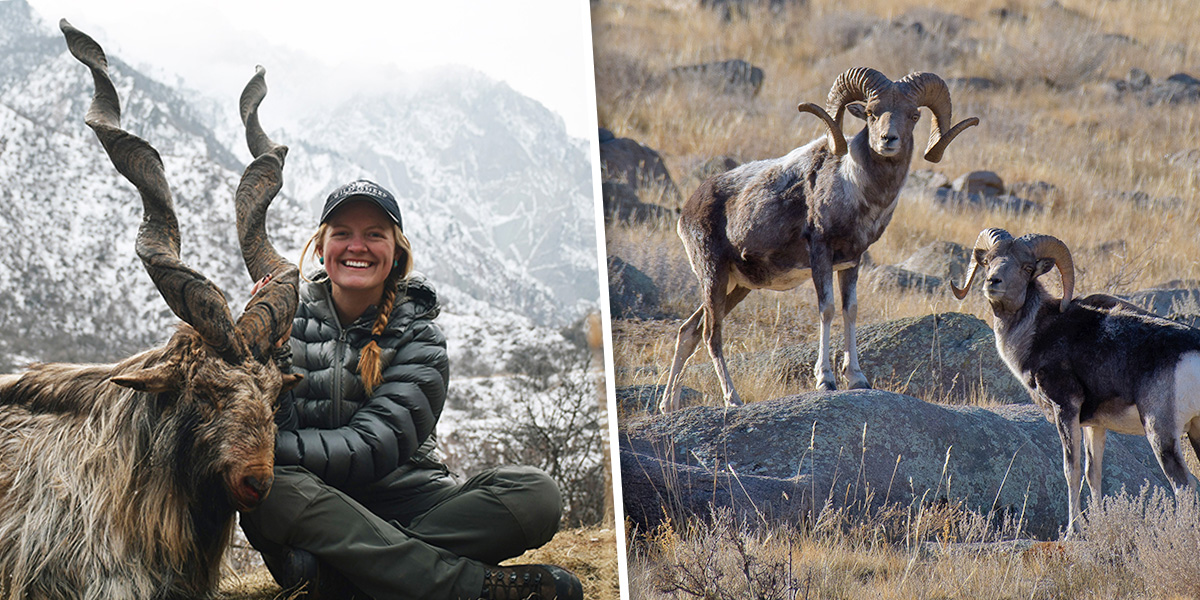
Each year at the Sheep Show, hunters, outfitters, conservation leaders, and wildlife officials gather not only to celebrate wild sheep, but also to address the practical realities of how international conservation and lawful hunting intersect. At the Wild Sheep Foundation’s (WSF) annual meeting, one of the most closely followed discussions focused on a topic central to that intersection: the process for importing legally harvested wild sheep and goats into the United States, and how that system has evolved in recent years.
Hosted by WSF, the session featured a detailed presentation by the U.S. Fish and Wildlife Service (USFWS) and drew attendees from across the United States, Canada, and Central Asia, including representatives from Kyrgyzstan, Mongolia, and Kazakhstan. The purpose of the meeting was to provide clarity on trophy import permitting, explain regulatory distinctions, and address long-standing misconceptions surrounding the process.
A Direct Line to the Permitting Process
Jacob Messler, a biologist with the U.S. Fish and Wildlife Service’s International Affairs Program, Branch of Permits, opened the session by emphasizing that his office exists to help hunters understand and navigate the trophy import process, while ensuring compliance with U.S. law and international agreements. He repeatedly urged people not to rely on rumors or forum chatter. “I consider the Fish and Wildlife Service, and myself personally, to be the greatest resource for importing your trophy into the United States,” Messler told the room.
Messler encouraged hunters, outfitters, and booking agents to contact his office directly with questions before or after a hunt, noting that early communication can help prevent delays later. He stressed that when the Service requests additional information, it is typically an effort to resolve issues and move an application toward approval, not to deny it.
Measurable Progress in Permit Processing
Messler reported that the trophy import permitting program has made substantial progress over the past several years, describing major improvements in turnaround times and capacity. According to him, most application types now have little to no backlog, and applications are generally reviewed in the order they are received. He stated that in calendar year 2025 the median processing time for permit applications was approximately 45 days, a significant improvement compared to earlier periods when applicants often faced extended delays. Messler noted that this was no longer a system where applications routinely sat for years.
Messler attributed these gains to increased staffing, internal process changes following a 2018 court decision that altered how enhancement findings are made, and stronger cooperation with conservation organizations and international partners. He also noted that certain steps, such as Federal Register publication for some ESA-endangered species, remain outside the control of his office and can affect timelines.
Understanding the Legal Framework
A substantial portion of the presentation was devoted to explaining the legal foundations of trophy import permitting, particularly the interaction between the U.S. Endangered Species Act (ESA) and the Convention on International Trade in Endangered Species of Wild Fauna and Flora (CITES).
Messler explained that the ESA generally prohibits the import, export, or transport of listed species unless authorized by permit. “It’s the law, there’s really no way around it except for exemptions, and permits are one of those exemptions,” he said. Under the ESA, permits function as exemptions to otherwise prohibited activities.
To issue a permit, USFWS must make an “enhancement of survival or propagation” finding, meaning the hunt must demonstrably benefit the species in the wild. As Messler explained, issuing a permit requires the Service to conclude that “this hunt benefited the species."
CITES, by contrast, is an international treaty focused on regulating cross-border trade to ensure it is legal and not detrimental to the survival of listed species. Depending on the species and its CITES Appendix listing, export permits, and in some cases import permits, are required, along with findings related to legal acquisition and non-detriment. Messler emphasized that there is no blanket ban on importing trophies of ESA-listed species.
“There is no ban on any species that is listed under the U.S. Endangered Species Act,” Messler said, so long as the applicant can show the hunt met the legal standard, namely that it benefited the species.
Threatened vs. Endangered Species
Addressing a common source of confusion, Messler explained that for sport-hunted trophies, the substantive biological criteria for species listed as “threatened” versus “endangered” under the ESA are largely the same.
“The requirements for those two listings are identical, literally identical,” Messler said, when it comes to trophies.
The key distinction lies in procedure. Applications involving ESA-endangered species generally must be published in the Federal Register for public comment, a process that can introduce delays beyond the direct control of USFWS. Threatened species typically do not require this step, allowing applications to move forward more quickly.
Country and Species-Specific Clarifications
Messler provided several important clarifications regarding Central Asian sheep and goats. Argali from Mongolia, the Kyrgyz Republic, and Tajikistan are listed as endangered under the ESA but are treated as threatened for permitting purposes under a special 4(d) rule. As a result, these populations do not require Federal Register publication, which has significantly streamlined processing in recent years. He also clarified a long-running point of confusion: Tien Shan argali taken in the Kyrgyz Republic cannot be imported into the United States because export is prohibited under Kyrgyz law.
“It is the case because it’s illegal under the laws of the Kyrgyz Republic,” Messler said, noting authorities there “don’t allow the export of Tien Shan.” Straight-horned markhor, by contrast, remains listed as endangered and therefore requires Federal Register publication, which can extend processing timelines due to factors outside the Service’s control. Messler also offered an important update, saying the Service is “very close” to finalizing permit applications for straight-horned markhor populations. He described it as significant progress for a species that has not seen consistent permitting movement in recent years, and said additional public communication would follow once the process is complete. Messler added that hunters should confirm the specific listing status of any markhor they pursue, since permitting requirements depend on how a population is classified under U.S. regulations.
Implementation Reports and Conservation Benefit
A recurring theme throughout the discussion was the importance of implementation reports and management plans prepared by hunting concessions or local authorities in range countries. These documents describe how revenue generated from hunting is used to benefit wildlife populations and habitat through actions such as anti-poaching efforts, habitat management, and monitoring.
Messler explained that USFWS often keeps these reports on file, meaning individual hunters may not need to submit them with every application. Hunters are encouraged to contact the Service in advance to determine whether the necessary documentation is already available.
Applying Early and Communicating Often
Messler strongly encouraged hunters to submit permit applications well in advance of their hunts whenever possible. “You can submit an application and get your permit before you even go on your hunt in a lot of circumstances,” he said.
In many cases, permits can be issued before a hunt occurs, with conditions requiring submission of final documents prior to import. He also reminded attendees that all wildlife imports, regardless of listing status, must be declared upon entry into the United States and inspected at a designated port.
The session concluded with acknowledgement from both USFWS and WSF representatives that improved communication, partnerships, and transparency have been central to recent progress. Messler emphasized his commitment to public service and encouraged anyone with questions or concerns about trophy imports to contact his office directly.
Tags: Advocacy, International, Sheep Show