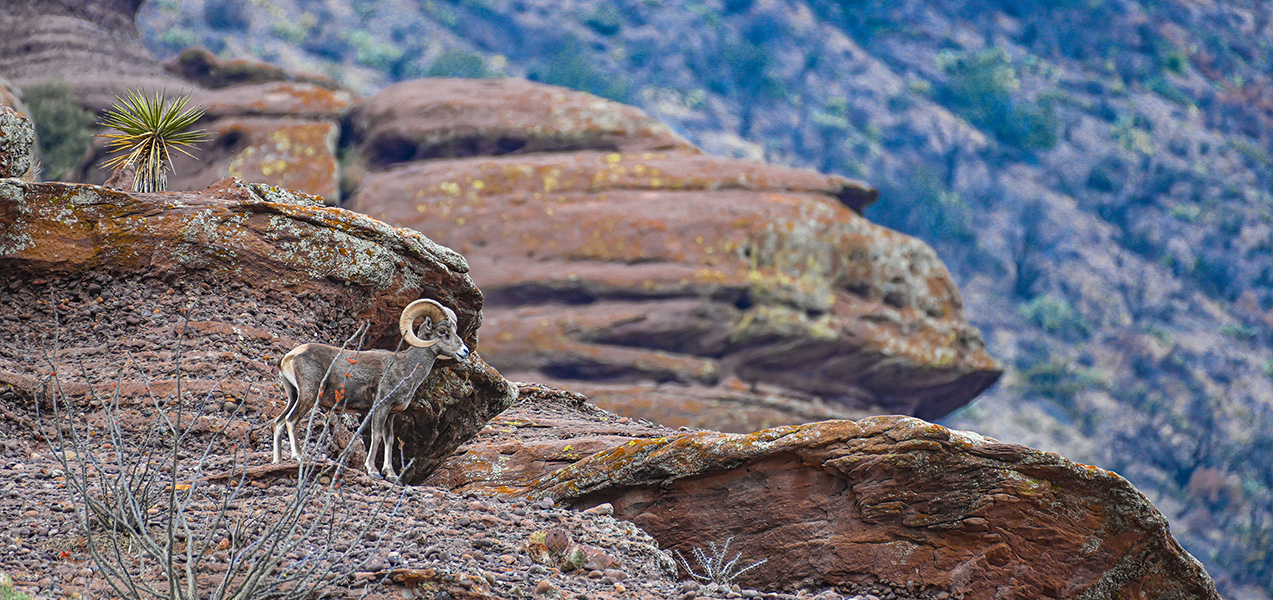
Desert bighorn ram in the Sierra Diablos. Photo courtesy Chris Stahl.
Texas desert bighorn sheep have faced a challenging stretch since respiratory disease outbreaks linked to Mycoplasma ovipneumoniae were first documented in 2019. But the most recent population survey results are offering renewed hope.
“Statewide population estimates show encouraging signs of recovery, with a slow but steady increase,” said Jose Etchart, Desert Bighorn Sheep Program Leader with Texas Parks & Wildlife Department (TPWD).
That progress is being tracked closely through TPWD’s annual fall surveys across the Trans-Pecos.
Surveying Desert Bighorns Across the Trans-Pecos
Each fall, beginning October 1, TPWD biologists conduct annual helicopter surveys to monitor desert bighorn populations across the Trans-Pecos region. At Elephant Mountain Wildlife Management Area (WMA), ground-based foot surveys are also conducted to improve detection and data reliability because of sheep behavior specific to that area. During surveys, biologists collect data on herd size, sex composition, ram age-class structure, lamb production, marked individuals, and the presence of aoudad.
In 2025, TPWD surveys observed 730 bighorns statewide. While still far below the survey peak of 1,236 bighorns documented in 2014, the 2025 total reflects a meaningful rebound from the post-outbreak low near 500 animals shown in the years following 2019.
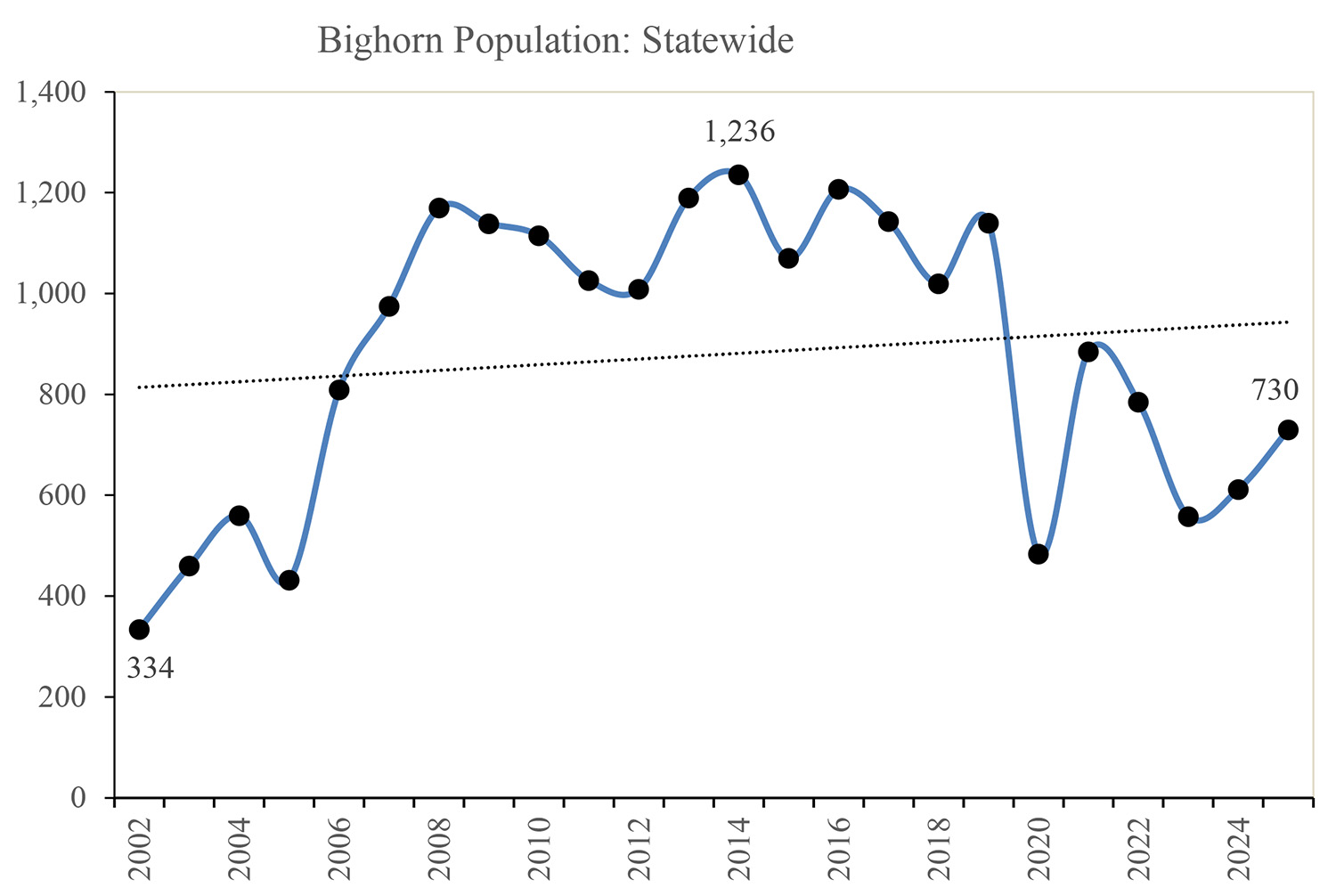
Statewide bighorn population by survey year from 2002 to 2025 with trend line.
The survey highlights how herd size varies across individual monitoring areas. In 2025, Sierra Diablo WMA supported the largest observed herd with 217 bighorns, while Elephant Mountain WMA held 152 animals and Black Gap WMA and the surrounding South Brewster County survey area recorded 139.
Additional monitoring areas, many spanning rugged mountain landscapes, including private lands, across the Trans-Pecos, were also surveyed in 2025, while Big Bend Ranch State Park is scheduled for flights in April 2026.
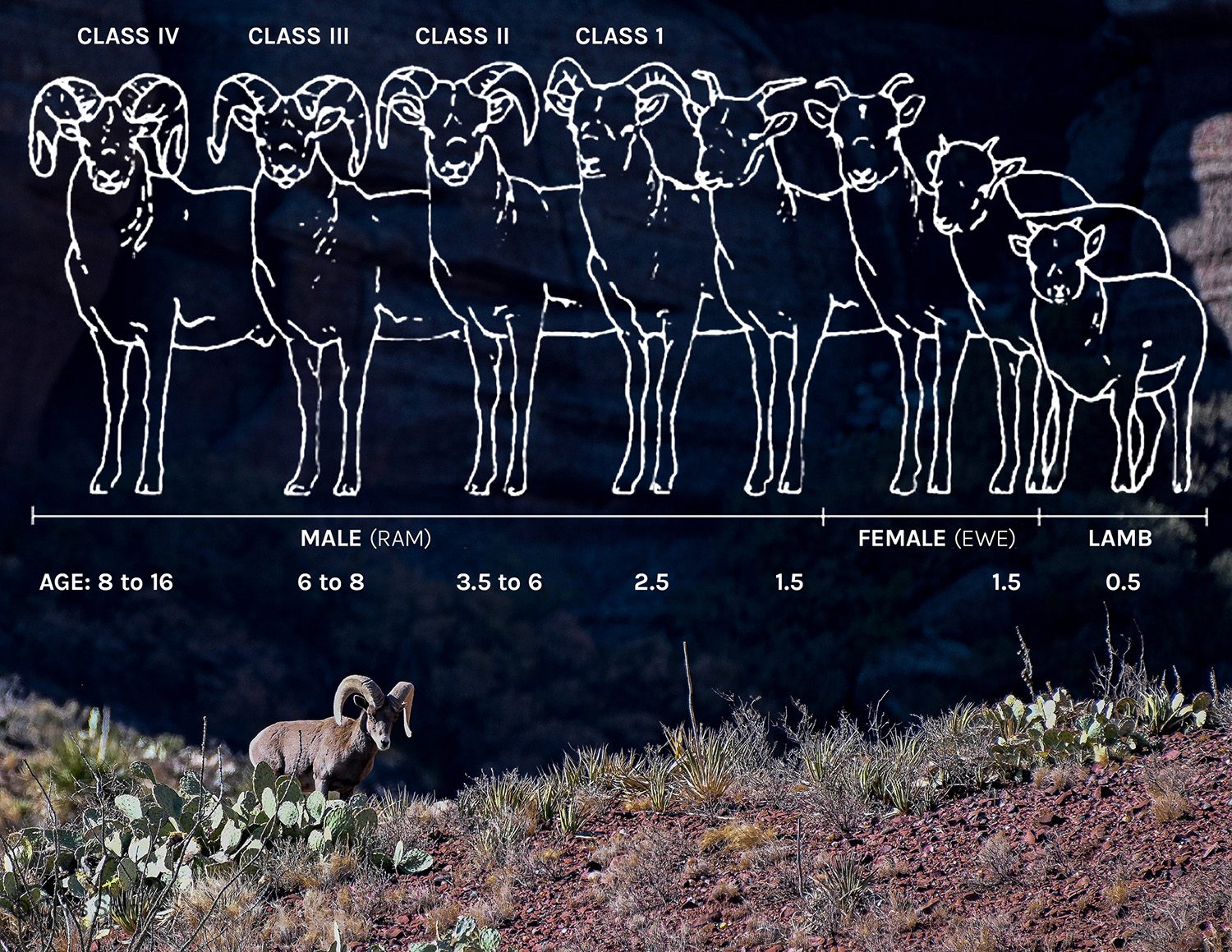
Ram and Herd Classification. Photo courtesy Chris Stahl.
Lamb recruitment varied widely by area. While the statewide lamb crop averaged 35 percent, Black Gap & South Brewster reported a higher lamb crop of 46 percent, compared to 23 percent at Elephant Mountain, 40 percent in Sierra Diablo, and 37 percent in Franklin Mountains State Park.
There is also good news in terms of age class. In 2025, TPWD observed 58 Class IV rams statewide, an important indicator of older-age rams across surveyed ranges. Elephant Mountain recorded 24 Class IV rams, while Sierra Diablo counted 13 and Black Gap & South Brewster recorded 11.
“Black Gap and Sierra Diablo WMAs are showing promising signs of population recovery, which is incredibly encouraging,” Etchart said. The report also identifies two areas where herds have remained strong and stable, with fewer impacts from major limiting factors: Elephant Mountain and the newly established desert bighorn herd in Franklin Mountains State Park. “Even better, both Elephant Mountain and the newly established herd in Franklin Mountains State Park remain strong and stable,” Etchart concluded.
These stable herds are important not only because they represent survival during a difficult period, but also because they provide benchmarks for what healthy herd structure and recruitment can look like under favorable conditions.
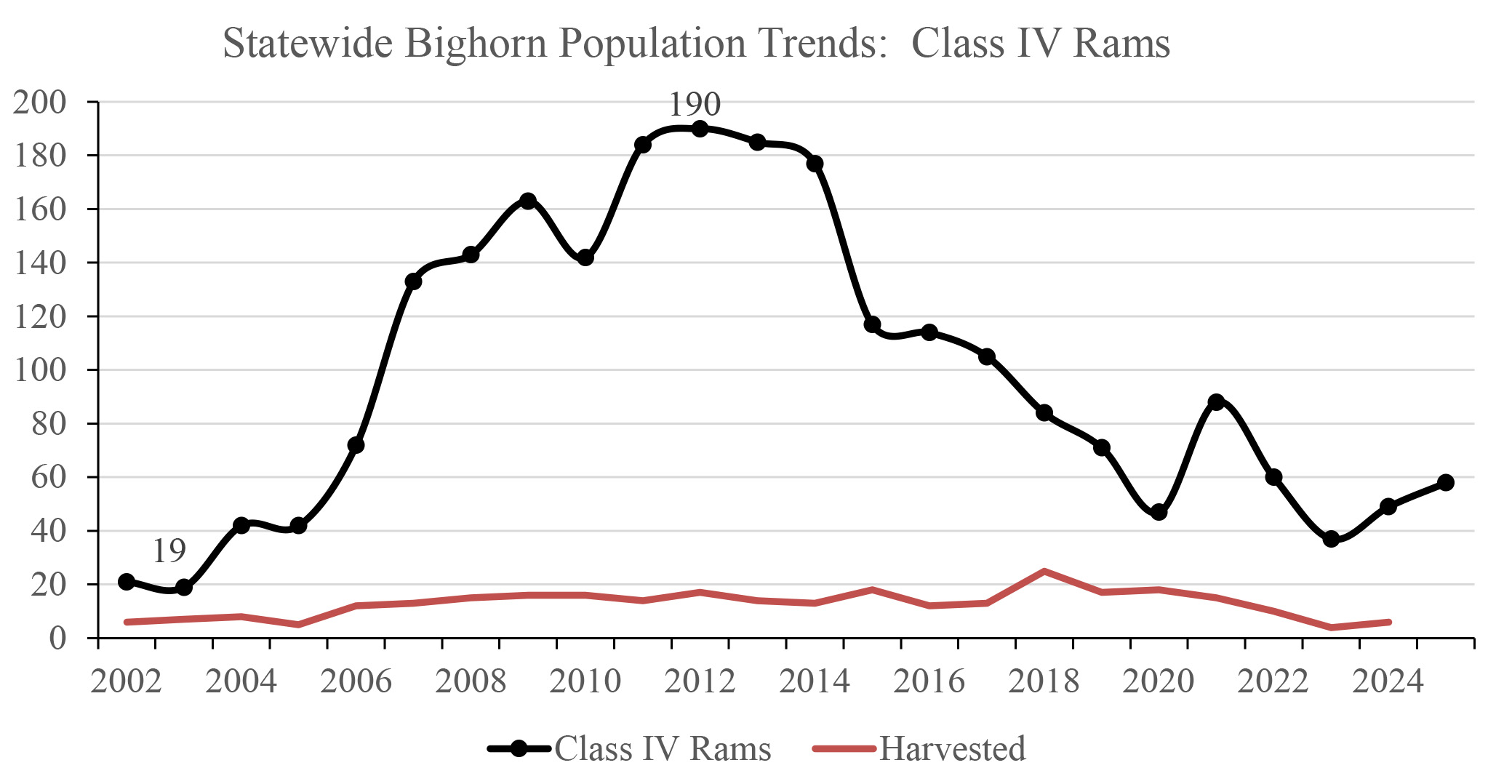
Statewide Class IV Rams observed and associated harvest for survey years 2002-2025.
Management Challenges: Aoudad, Habitat, and Disease
Desert bighorns in Texas continue to face challenges from multiple interacting factors, including prolonged drought, disease, competition with aoudad, and predation. The 2025 report emphasizes that significant reductions of overabundant aoudad populations remain one of the most critical management actions supporting bighorn sheep recovery. Aoudad reductions improve forage availability and decrease opportunities for disease transmission to bighorn sheep.
TPWD is developing a program to assist landowners with effective aoudad management techniques. The report also notes that healthy, diverse habitat is a fundamental component of sustainable wildlife populations. Proper livestock and wildlife population management, brush management, and strategically placed water developments are essential to maintaining suitable habitat conditions.
TPWD is establishing a disease surveillance program responsible for strain typing outbreaks throughout the Trans-Pecos to correlate strain types with population mortality effects. And while challenges remain, the mountains are also beginning to tell a better story.
Franklin Mountains: A Restoration Milestone
Franklin Mountains State Park is the most notable recent development in Texas desert bighorn conservation. The return of desert bighorns to this range marks a historic moment in a place where they had been absent for more than a century. This achievement reflects the strength of conservation partnerships. The Texas Bighorn Society, Wild Sheep Foundation and their partners played a major role in supporting the Franklin Mountains restoration effort alongside TPWD, helping make the return of desert bighorns possible.
That work included a major restoration effort that began with the release of 77 desert bighorn sheep into Franklin Mountains State Park on December 6, 2024. The release included 40 ewes and 37 rams, all translocated from Elephant Mountain according to TPWD. These animals formed the foundation of a new herd in the park, marking one of the most significant desert bighorn restoration steps in modern West Texas history.
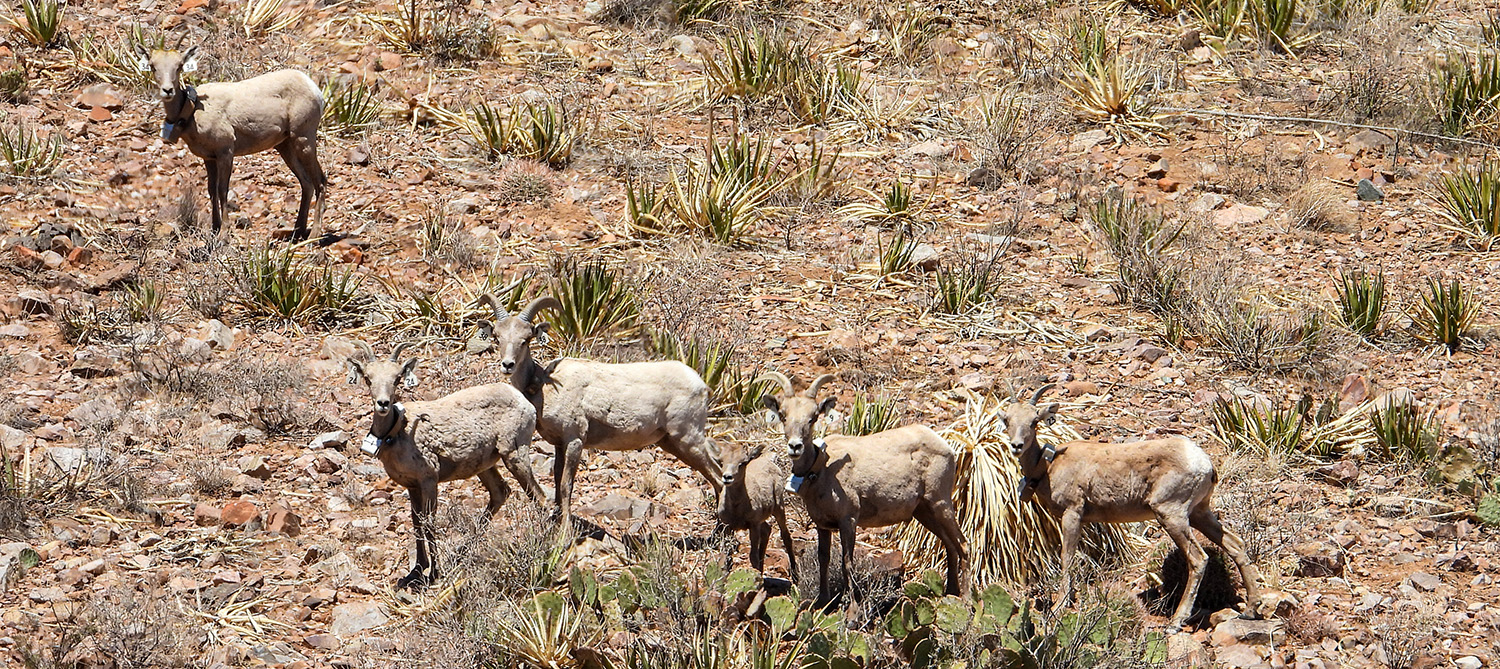
Translocated desert bighorns in the Franklin Mountains State Park. Photo courtesy Matthew Montoya TPWD.
In Spring 2025, the first desert bighorn lambs were born in this range in over a century. Survey observations from 2025 recorded 84 bighorns in Franklin Mountains State Park, including 13 lambs. Those early results are especially important because they show both herd stability and successful lamb production within the first year of establishment.
“This highly successful restoration shows what can be done for wild sheep when people come together,” said Corey Mason, Chief Conservation Officer for WSF. “As both a Texan and someone working for WSF, watching those desert bighorns step out of the trailer and into their new habitat truly put an exclamation point on our mission: ‘To put and keep wild sheep on the mountain.’”
Looking Ahead
This recent information provides valuable direction for ongoing desert bighorn conservation work in Texas. While challenges remain from drought, disease, competition with aoudad, and predation, the report confirms that progress is being documented and that certain management areas are showing improvement.
“These findings give us valuable direction for our ongoing conservation work,” Etchart said. “The varying outcomes across different areas show us that targeted, localized strategies can make a real difference, and we're committed to building on the successes we're already seeing.”
With continued monitoring, habitat restoration, aoudad management, and expanded disease surveillance, the 2025 report underscores a hopeful truth: desert bighorn sheep are starting to climb back.
Across the Trans-Pecos, the recovery effort is advancing range by range, herd by herd, guided by both the challenges faced and the progress now making its way into the high desert peaks.
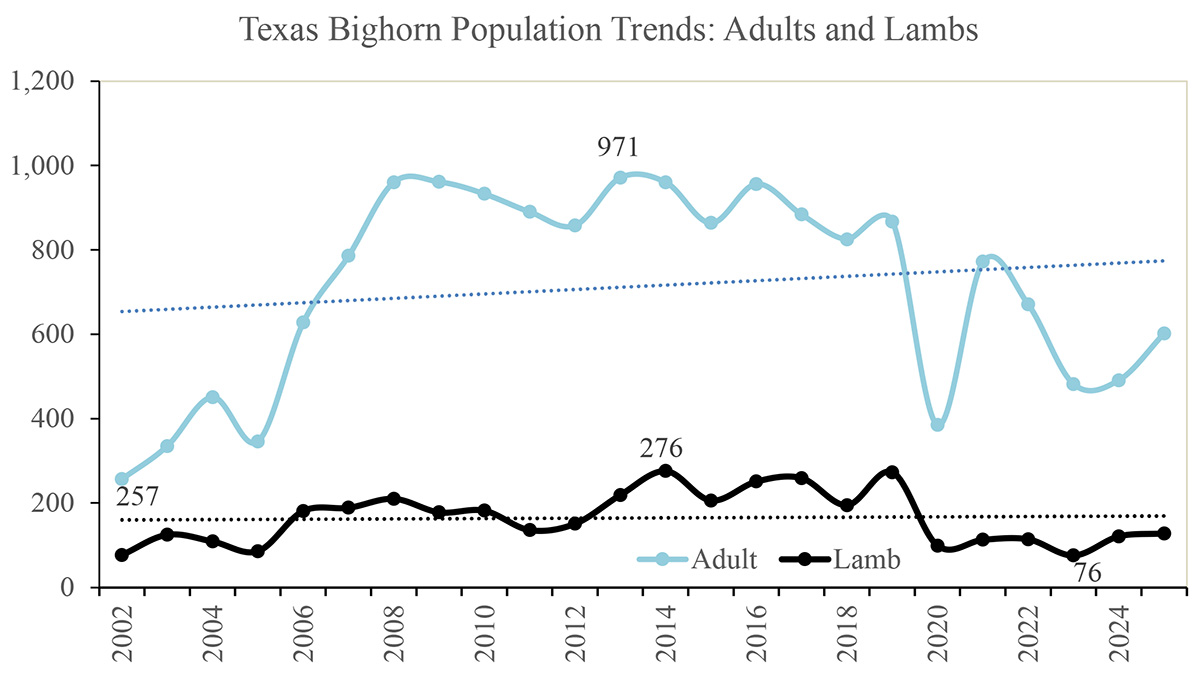
Statewide bighorn population by adults and lambs with trend lines by survey year from 2002-2025.
BONUS CONTENT
WSF, Texas Bighorn Society, and Partners Driving Desert Bighorn Recovery
Wild Sheep Foundation works with a broad network of chapters and affiliates across North America to help accomplish its mission. These groups raise funds and support hands-on conservation projects that benefit wild sheep in their respective regions and beyond. One of the long-standing partners in that network is the Texas Bighorn Society (TBS). Founded in 1981, TBS has played a leading role in desert bighorn restoration for more than four decades, helping drive habitat work, guzzler placement, advocacy, and cooperative efforts across the Trans-Pecos.
The Franklin Mountains project was powered by a Texas-sized coalition that included WSF, the Texas Bighorn Society, the WSF Midwest Chapter, the WSF Eastern Chapter, Bass Pro/Cabela’s Outdoor Fund, the Campfire Conservation Fund, the Houston Safari Club Foundation, and the Water For Wildlife Foundation, along with additional WSF chapters supporting long-term water developments.
Together, these organizations are proving what conservation can accomplish when people unite behind a common goal. With sustained support, desert bighorn sheep are returning to the rugged mountain ranges of West Texas, a comeback that will echo across the peaks for decades to come.
Contributing Author: Chester Moore is an award-winning wildlife journalist, wildlife photographer, and lifelong hunter from Texas. He operates the Higher Calling Wildlife® blog and podcast and contributes to many outdoors publications.
Tags: Desert Bighorn