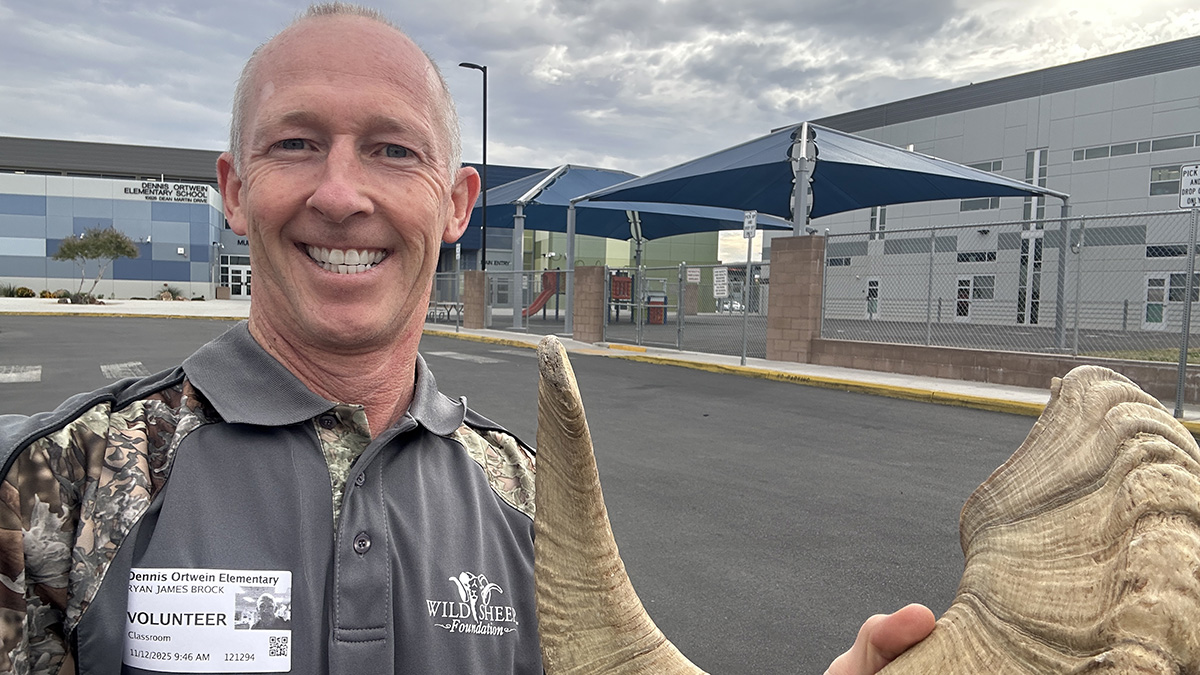
Recently, our Shooting, Hunting & Ethics Education Program (S.H.E.E.P.) coordinator, Ryan Brock, was able to visit southern Nevada to help students in the Silver State better understand their state mammal, the desert bighorn sheep.
Over a three-day period, Dr. Brock visited three elementary schools on the south side of Las Vegas. These included: Ortwein Elementary, Bass Elementary, and Ries Elementary. All classrooms that participated were fifth grade.
The assemblies utilized a PowerPoint to pull them into the context using various photographs, maps, and videos to help them visualize different aspects of wild sheep. Additionally, hands-on items such as skulls, horns, hides, and legs kept them engaged. Key aspects presented on included introducing the species of bighorn and thinhorn sheep in North America, adaptations of these wild sheep, and conservation efforts taking place to help put and keep these sheep on the mountains across the continent.
“It was unbelievable the amount of students who had a hard time understanding that the skulls and hides were from real bighorn. It was obvious quickly the limited time most of these inner-city youth had with wildlife,” Ryan recalled after presenting at the final school. “Their eyes were as wide as saucers as they just kept asking over and over, ‘Those are really from a real bighorn’.”
One school in particular had 100% of its 772 students categorized as economically disadvantaged. Another school visited had students where only 44% of the students scored proficient in math and 41% in reading. The third school visited was a combination of the two other schools with proficiency in the upper 30% range and also having 100% of its students categorized as economically disadvantaged. It is these schools who usually don’t possesses opportunities for enrichment like this. In many elementary schools today, those schools who lack proficiency in the basic subjects often time add additional instructional time to the core subjects while pulling minutes away from less testable subjects such as science and social studies.
 The Wild Sheep Foundation is grateful these schools welcomed us into their communities to help enrich their students’ education. In all, 276 students learned a variety of scientific concepts and some key conservation tactics that are helping wild sheep today.
One school sent thank you letters about their learning experience. One 5th grader, Rita Gonsales, wrote, “I wanted to say think you and that I never thought that a sheep would eat something and then wait and it [would] come back up to chew it again.” Surely one of the favorites of the presentation for most kids involved learning about the 4-chambered stomach of ruminants and watching a short video of a bighorn chewing its cud.
“Science can be so fascinating,” Brock explained, “You just have to know how to take the unique qualities of the subject matter and show how it relates, or in the context of the sheep chewing its cud, or contrasts to their child’s life.
Although not as educational as many other lines that could be quoted from the letters of the students, the one that seemed to bring the largest smile to Ryan when he read the letters was in reference to when he spoke to students about the “six or seven key adaptations that help wild sheep survive.” If you have been around ANY kids in the past few months, you can visualize every student holding their hands out in front of them, palm side up, raising one hand and then the other and repeating back to him, “Six…..seven….”. Being a daily occurrence back in Dr. Brock’s classroom, he knew what must be done and simply put his hands up and said, “Yes, six……or seven…… key adaptations.”
The line from the thank you letter circled back to that moment from the presentation. Nadia said it simply, and what we could all agree with. “We would love to save 6…..7…..more sheep!”
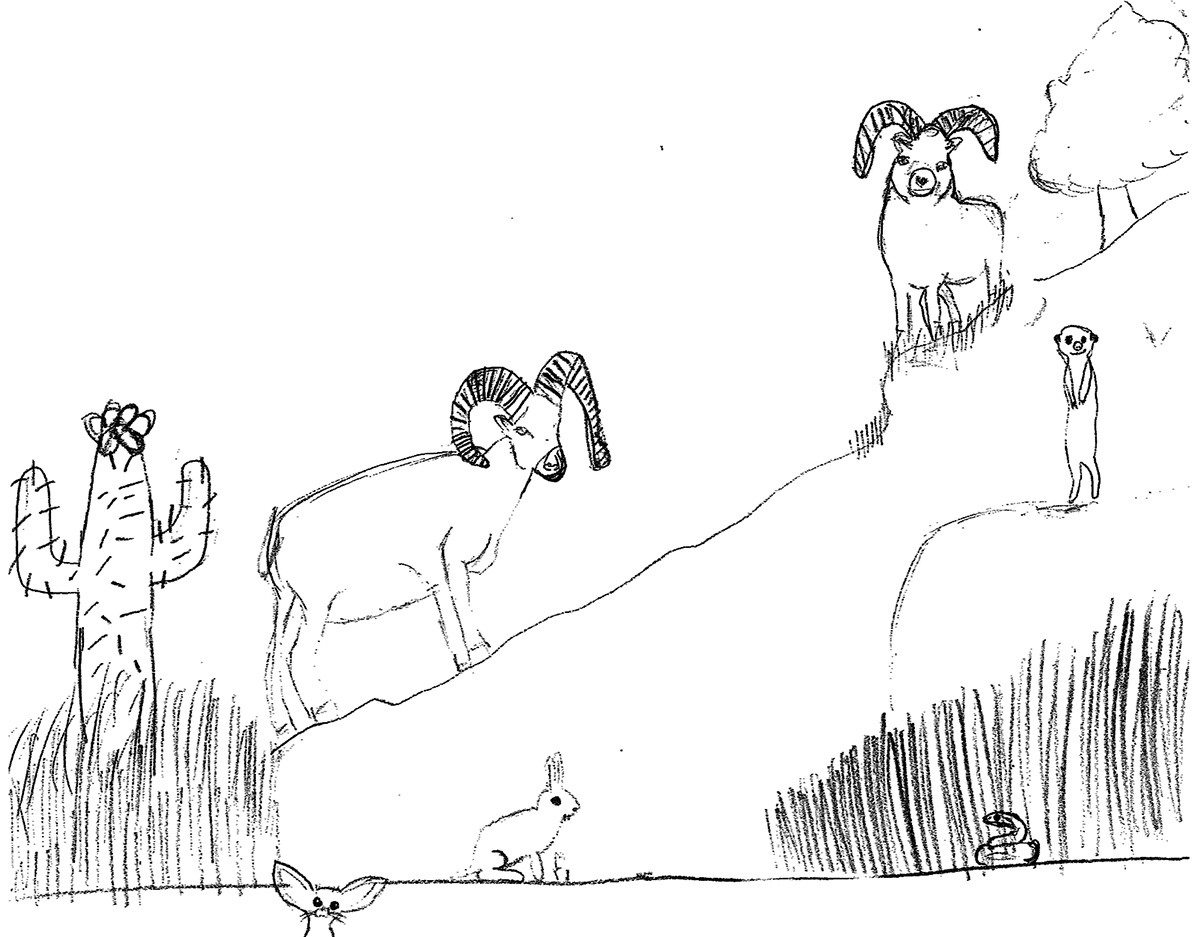
One student named Noah sent this drawing to accompany his thank you letter.
Tags: Youth