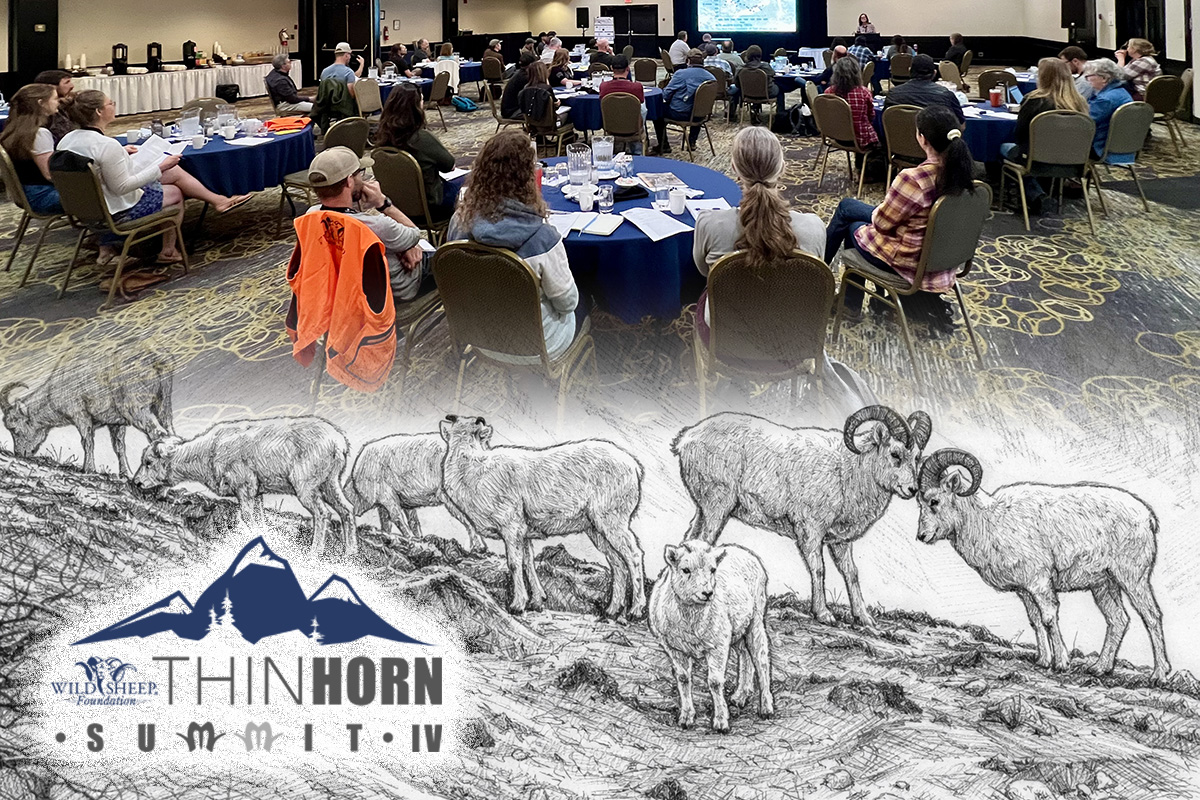
Bozeman, MT — The Wild Sheep Foundation (WSF) recently concluded its fourth Thinhorn Summit, bringing together leading wildlife professionals, researchers, conservationists, Indigenous representatives, outfitters, and sportsmen and women focused on the future of Dall’s and Stone’s sheep conservation across northwestern North America.
Held in Prince George, British Columbia, the 2026 Summit welcomed more than 65 in-person participants, with an additional 24 attendees joining virtually. Previous summits were hosted in British Columbia (2014), Alaska (2017), and Yukon (2022).
“This was a necessary next step,” said Bill Jex, WSF’s Thinhorn Sheep Program Lead. “The first Thinhorn Summit created a collaborative network that helped identify the initial challenges facing thinhorn sheep across their range. We left that meeting with clear priorities and goals to pursue in the years that followed.”
Building on the momentum of the first three summits, this year’s event focused not only on sharing current science and conservation successes but also on translating those lessons into practical, actionable tools that attendees can apply in their own jurisdictions and projects.
“The goal was to create a body of reference materials, planning tools, and implementation strategies so attendees can return home prepared to launch or strengthen projects that benefit thinhorn sheep,” Jex added.
Participants represented a broad cross-section of conservation interests, including state and provincial wildlife agencies, First Nations, WSF Chapters and Affiliates, students, guides and outfitters, and local hunting and conservation communities.
“From Alaska to British Columbia, we came together with a shared commitment to do more for wild sheep,” said Corey Mason, Chief Operating Officer and Executive Vice President of Conservation for WSF. “The diversity of perspectives at this Summit strengthens our ability to address emerging challenges and build resilient thinhorn populations across their range.”
The two-day agenda focused on applied conservation science, climate resilience, habitat management, wildlife monitoring, and practical field techniques to enhance and sustain thinhorn sheep populations.
Summit topics included:
- Understanding current and projected climate and precipitation changes that affect sheep movement, survival, and population dynamics to improve conservation planning
- Using remote cameras and satellite imagery to monitor populations, snow cover, and avalanche risk
- Measuring stress responses, nutrition, fitness, and habitat use in wild sheep populations
- Evaluating the effects of large-scale wildfire and prescribed fire on habitat quality and resilience
- Reducing impacts from industrial and recreational vehicle activity in sensitive habitats
- Improving understanding of hunter perceptions and sheep behavioral responses to hunting pressure
- Standardizing wildlife sampling methods for hunter-harvested animals
Gray N. Thornton, President and CEO of the Wild Sheep Foundation, reflected on the progress made since the inaugural Summit in 2014.
“Our purpose from the beginning was to ensure Dall’s and Stone’s sheep did not experience the devastating pathogen transfer and large-scale die-offs that affected many bighorn sheep populations farther south,” Thornton said. “Since that first Summit, northern jurisdictions and conservation partners have made meaningful progress in thinhorn sheep management and conservation, and WSF is proud to support and encourage that growing commitment.”
Jex also recalled a defining question posed during the 2022 Summit in Whitehorse.
“Gray asked, ‘What can we do for thinhorn sheep?’” Jex said. “The work accomplished in Prince George was our effort to answer that question with practical solutions and collaborative action.”
The Wild Sheep Foundation remains committed to supporting science-based conservation initiatives and collaborative partnerships that ensure healthy, sustainable populations of Dall’s and Stone’s sheep for future generations.
About the Wild Sheep Foundation
The Wild Sheep Foundation (WSF), based in Bozeman, Montana, is a leading international conservation organization dedicated to wild sheep and their habitats. Founded in 1977 by sportsmen and conservationists, WSF has invested more than $156 million in conservation efforts worldwide. Through initiatives focused on habitat enhancement, population restoration, scientific research, education, and advocacy, WSF works to fulfill its mission to “Put and Keep Wild Sheep on the Mountain®.” These efforts have helped restore North American bighorn sheep populations from historic lows of approximately 25,000 in the mid-20th century to more than 85,000 today.
WSF serves a global membership of more than 11,000 supporters and collaborates with partners across North America, Europe, and Asia to ensure a sustainable future for wild sheep. Learn more at www.wildsheepfoundation.org.
Tags: Stone's Sheep, Dall's Sheep, Press Release