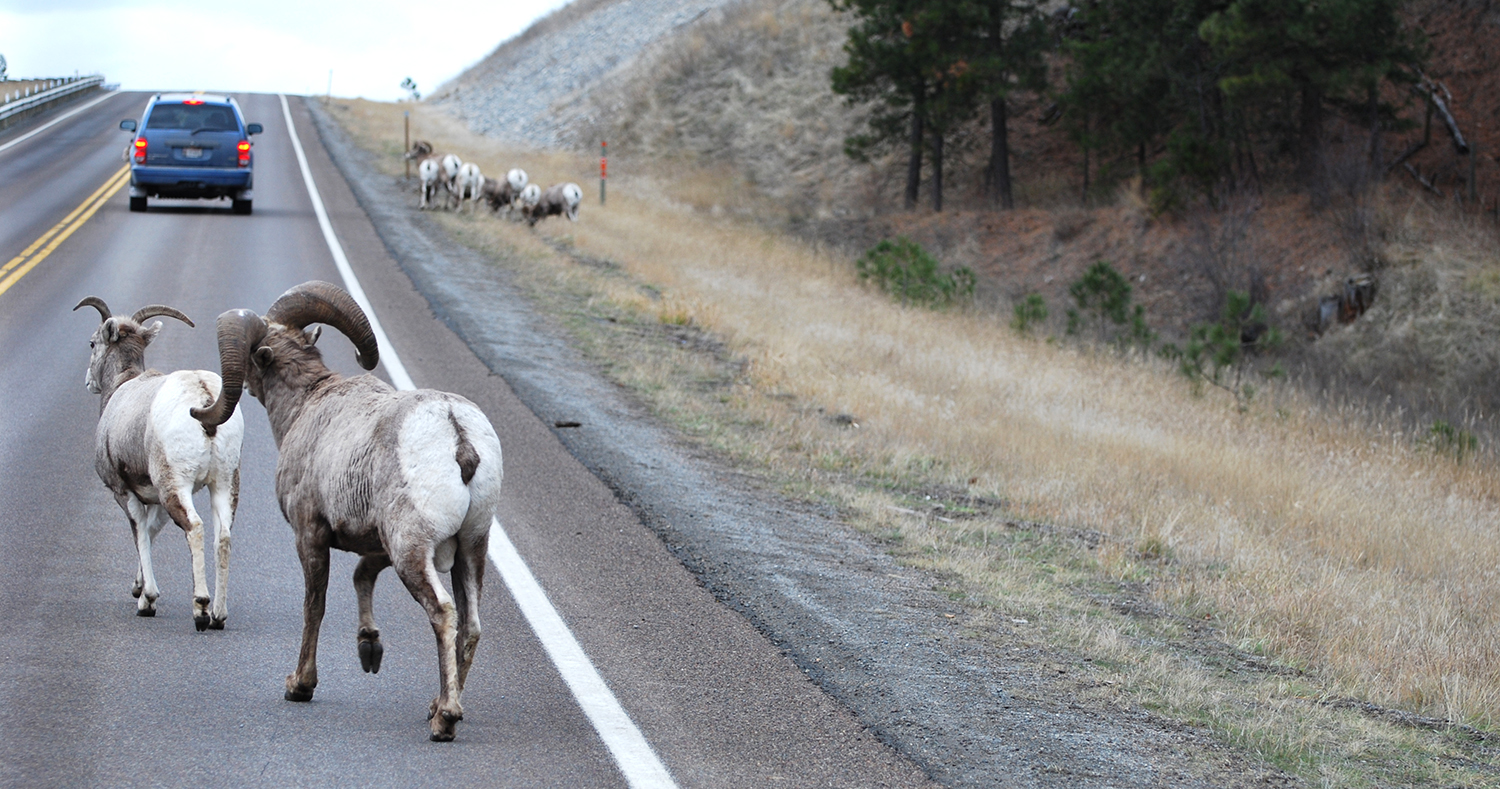
Photo courtesy Justin Phillips
A couple of years ago, I got to thinking about the Ural/Tweed bighorn sheep herd that once existed along the Kootenai River corridor between the Tobacco Valley and Libby, Montana. Unit 101 had not appeared in the bighorn regulations for years, so I called Ethan Lula, the Montana Fish, Wildlife and Parks biologist in Eureka, to see if the herd still survived. Ethan enthusiastically called me back to report that he had two sheep collared, but the herd was down to 25-30 animals. Seven had been killed by motor vehicles on Highway 37 in two collisions in 2022-2023.
 This herd of native Rocky Mountain Trench genetics once flourished on both sides of the Kootenai River, on bottomland, steep rocky bluffs, and open slopes from Stone Hill to Cripple Horse Creek on the Salish Mountain (east) side and the Purcells on the west. This area spans more than 20 miles and 3,000 feet in elevation change. The herd numbered 150-200 in the 1960s but plummeted to 20-25 in the 1970s during construction of Libby Dam (completed in 1974). This was a result of poaching (personal communication from those who were there), clearing of river-bottom habitat, and splitting of the herd (the west-side metapopulation died out).
The population rebounded to 150-200 by the early 1990s but declined rapidly with wolf reintroduction. Then, increased Highway 37 traffic resulted in more vehicle collisions, and forest succession became a limiting factor.
I have photos I took in 1991 of the entire range, and the contrast with my current photos is dramatic. We last had one ram permit in Unit 101 in 1999. Population estimates in the last five years have ranged from 25-30 to 30-40. Ethan Lula reports that traditional aerial or ground surveys are not possible due to terrain and timber canopy. The 2025 estimate, based on highway observations and lidar testing, was 40. The last known highway death was in 2023, but I get frequent reports of sheep on the highway.
The animals appear healthy and well-nourished, but recruitment is low, suggesting a predator-pit scenario. Their range is now limited to a remnant of what it once was. Our biology master's student helped Ethan replace a ram's collar last fall. I believe three are collared now.
So what can we do to help this herd of native bighorns, one of only two west of the Divide?
-
Reduce highway mortality. I list this as the highest priority because one truck could take out three or four sheep and bring the population to the brink of extinction. Highway 37 is a two-lane highway with fast-moving, large-vehicle traffic. The sheep use it to move from one ridge to the next, avoiding the timbered draws. The highway is cut through the ridges, creating vertical cliffs where sheep can be trapped. The Department of Transportation will not eliminate the use of road salt because of safety and legal issues. Steep terrain and cliffs preclude overpasses, which cost millions and take more than a decade to plan and complete. Underpasses are possible where the highway crosses drainages. Sheep and deer use a couple now for lake access. But fencing and electric pads would then be required to keep sheep and deer from becoming trapped by the cliffs on their return. Most of the drainages contain water, so lake access may not be needed. I have advocated the use of thermal detection (or radar, etc.) to alert motorists via activated flashing signs when sheep are on the highway. High-risk stretches are short enough for these systems to work. They have been very helpful for elk in Arizona. Fencing the highway between cliffs at high-risk drainages where water sources exist on the uphill side (see photos) is an obvious fix, requiring no road construction. LEFT: Bridge used as underpass by sheep and deer. RIGHT: Cliff along highway. Sheep use the edge to get to highway and next ridge.
-
Expand core habitat. This is a priority for the long-term survival of the herd. Lightning-caused fires reportedly have been much less frequent since the reservoir was created (personal communication). The USFS has periodically used prescribed burns to attempt to open the forest canopy, but they have tended to be ground fires that clear the understory, not the mature ponderosa pine and Douglas-fir timber. One was completed this winter. Helicopter logging of the steep slopes has not been available in recent years but should be considered. Understory prescribed burns in 2026.
-
Selectively remove mountain lions until the population reaches 100. This would help alleviate the predator-pit situation. Wolves are not thought to be the primary predator now but could eliminate the herd if they found it.
-
Discourage anything that increases Highway 37 traffic. There is a two-lane road on the west side of the reservoir that has been paved. Encourage its use. Unfortunately, the state has approved a new RV park near Libby Dam, which is certain to increase large-vehicle traffic.
-
Translocations. This could be used as a temporary measure while working on all of the above. But the source must be the Galton herd on both sides of the British Columbia border north of Eureka, since it is the other Rocky Mountain Trench herd. This would also help with potential inbreeding problems in the small population.
My hope is that by publicizing the plight of this once-thriving native herd, public interest and input will help move it closer to becoming a top priority for Montana FWP, the USFS and the DOT.
Tags: Bighorn Sheep, Conservation