One of the most important parts of the Wild Sheep Foundation’s mission is ensuring that the next generation understands the value of wildlife, wild places and conservation. One way the Foundation is doing just that is through our Teacher Check-Out Kit, a hands-on educational resource designed to bring the world of wild sheep directly into classrooms.
The program is already making an impact. Last year, the kits were used in 10 schools across the country, reaching 475 students. This year, the program is growing even further. Four schools have already hosted a kit, with another seven schools currently scheduled, representing a potential reach of approximately 675 students this school year.
And the interest isn't limited to the United States. A classroom at Sandgate State School in Australia recently expressed interest in learning about wild sheep—even though wild sheep don't live on their continent. While shipping the entire Teacher Check-Out Kit internationally isn't practical, the Foundation worked with the school to provide educational information and consumable materials that students can use and keep. It is a great example of how the message of wild sheep conservation can travel far beyond the animals' range.
 The Teacher Check-Out Kit is much more than a collection of lesson plans. It gives students an opportunity to investigate wild sheep the way a wildlife biologist might.
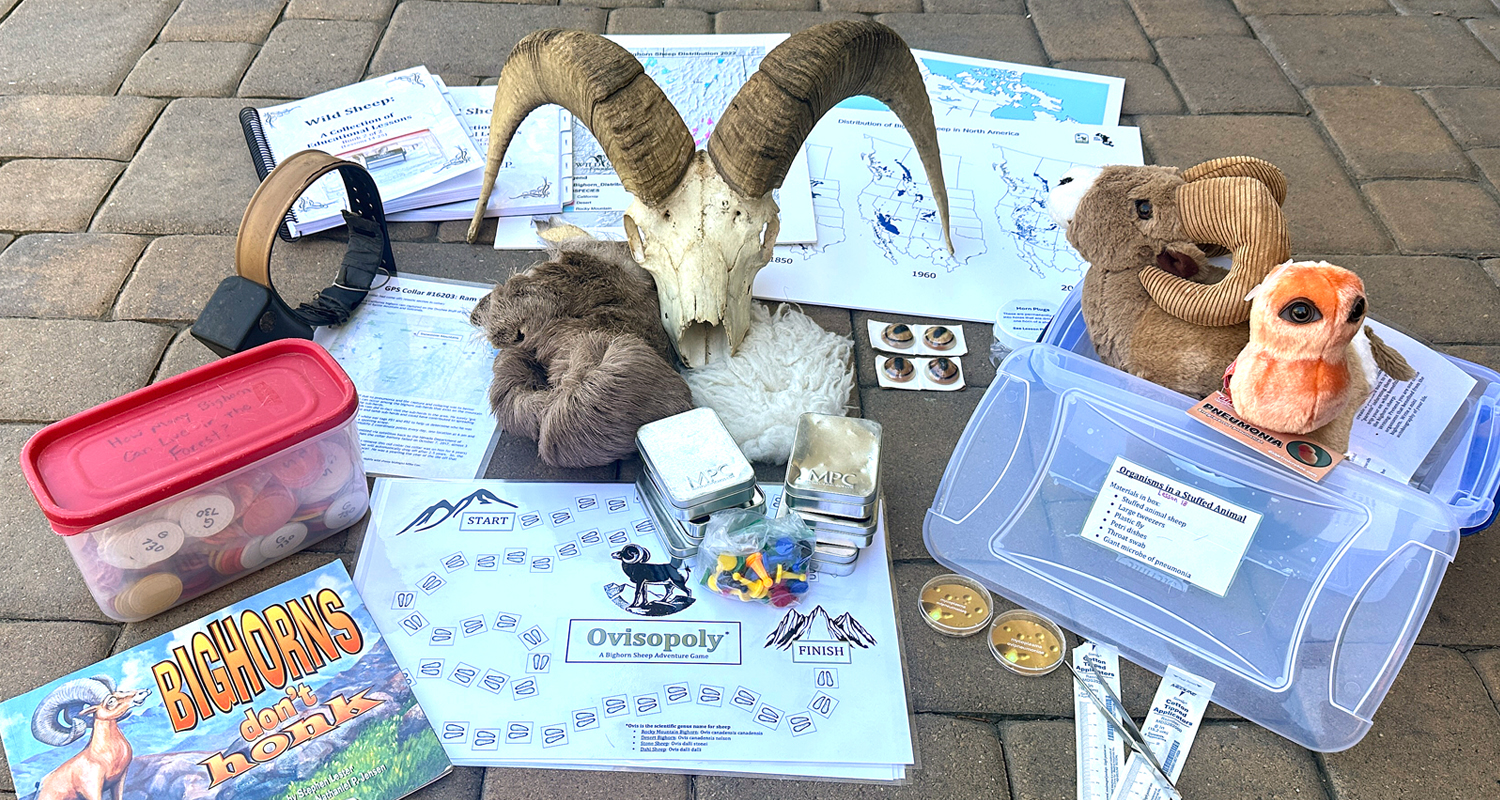
The kit includes an actual bighorn sheep skull, radio-tracking collar, hair and hide samples, reproduction specimens of glass eyes, horn plugs, population maps and the Ovisopoly wild sheep adventure game. It also includes two volumes of curriculum containing 27 lessons, along with a USB drive filled with PowerPoint presentations, videos, worksheets and other teaching resources.
The lessons are designed for a wide range of ages, from elementary through high school, with the majority well suited for upper elementary classrooms. Students can explore how the physical characteristics of wild sheep help them survive, investigate the food, water, shelter and space required by a healthy herd, and learn how disease can affect an entire population. They can even participate in activities that demonstrate how pneumonia can spread through a herd in a physical education game.
Other lessons put students in the role of wildlife researchers. Students work with real wild sheep population data, calculate population estimates, create graphs and investigate why individual herds are increasing or declining. Teams become the experts on one of six actual bighorn sheep herd and present their findings to the rest of the class.
The curriculum also introduces students to the complexities of conservation. Lessons explore habitat fragmentation, roads, water developments, feral horses, predator-prey relationships, translocations and other challenges facing wild sheep. Students aren't simply told what the answer is—they are asked to examine evidence, consider different perspectives and develop their own solutions.
Although wild sheep are at the center of the program, the lessons provide opportunities to teach much more than wildlife biology. Students use mathematics to analyze populations and resources, science to investigate adaptations and ecosystems, English language arts to write historical fiction and persuasive pieces, social studies to explore the relationship between early people and wild sheep, and even art and physical education through activities incorporated into the curriculum.
The lessons also provide natural connections to the Next Generation Science Standards, particularly concepts involving what animals need to survive, habitats, adaptations, population changes and the effects of environmental change. For example, NGSS includes K-LS1-1 on identifying patterns in what animals need to survive, 2-LS4-1 on comparing the diversity of life in different habitats, 3-LS4-3 on how organisms survive differently within particular habitats, and 4-LS1-1 on how animal structures support survival and reproduction.
|
NGSS - Science
(Grades K-5)
|
ELA - Literacy |
Social Studies |
Mathematics |
- K-LS1: Living things
- 1-LS1: Basic needs
- 2-LS4: Habitats
- 3-LS4: Ecosystems
- 4-LS1: Adaptations
- Additional MS standards also supported
|
- Informational writing
- Narrative writing (historical fiction)
- Research
- Speaking and listening
- Poetry
|
- Early peoples (Sheep Eater Shoshone)
- Human-environment interaction
- Multiple perspectives
- Civic decision-making
|
- Data analysis
- Graphing
- Population estimates
- Problem solving
- Real-world applications
|
But perhaps the most important outcome isn't a particular standard or lesson.
It's a student holding a real bighorn skull for the first time. It's a class discovering how wildlife biologists track an animal with a radio collar. It's a group of students looking at 20 years of population data and trying to determine what happened to a herd. It's a child realizing that the wild sheep they are learning about are part of a much larger story involving habitat, people, science and conservation.
Those are the experiences that can create a lasting connection to wildlife.
There are still dates available for teachers to check out the Teacher Kit this school year. If you are a teacher—or know a classroom teacher who may be interested—we would love to get the kit into their school.
To reserve a date, contact Ryan Brock. Shipping is provided by the Wild Sheep Foundation, making it possible for classrooms across the country to participate.
Through these kits, we aren't just teaching students about wild sheep. We're helping introduce the next generation to wildlife, conservation and the important role they can play in protecting it.
Tags: Youth